Irvine lies on an alluvial plain underlain by Pleistocene terrace deposits and Holocene channel fills, a geology that produces highly variable subgrade support within the same street segment. For road design, ASTM D1883-16 governs the California Bearing Ratio test, and we follow Caltrans’ Highway Design Manual Chapter 630 for structural section thickness. In Irvine, where residential streets bear light traffic but must also withstand occasional construction haul loads, a proper CBR study prevents overdesign that wastes budget or underdesign that leads to premature failure. We combine field sampling with laboratory soaked and unsoaked CBR curves to match the moisture regime typical of Orange County’s semi-arid climate with seasonal winter rains.
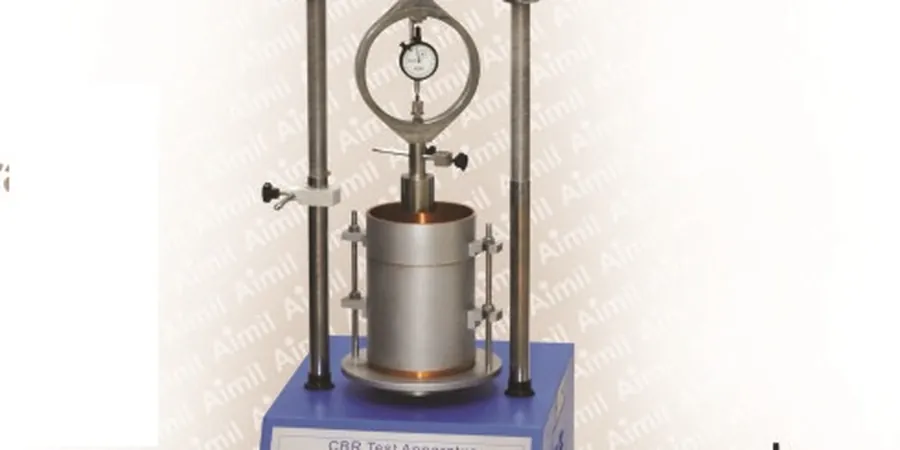
Soaked CBR values in Irvine’s A-2-4 sands typically range from 15 to 35, but clay-rich lenses near the Santa Ana River can drop below 8.
Methodology and scope
- We extract bulk samples from subgrade at proposed pavement depth, typically 300 to 600 mm below finished grade.
- Moisture-density relations are established via ensayo Proctor to prepare specimens at optimum moisture content.
- We run both unsoaked and 96-hour soaked CBR tests to simulate worst-case saturation after winter storms.
- For streets near the San Diego Creek floodplain, we also perform evaluación de pavimentos to assess existing pavement structural capacity before overlay design.
Local considerations
A common mistake we see in Irvine is contractors skipping the soaked CBR test because the site appears dry. They assume the subgrade will never reach saturation. But the A-2-4 sands typical of the Irvine Ranch area have low capillary rise yet high permeability, meaning a prolonged wet season or a broken irrigation line can saturate the subgrade within hours. When the soaked CBR comes in below 10, the pavement section designed for dry conditions will crack within two years. We always insist on the 96-hour soak, even for streets that seem well-drained.
Applicable standards
ASTM D1883-16 – Standard Test Method for CBR of Laboratory-Compacted Soils, Caltrans Highway Design Manual Chapter 630 – Pavement Structural Section, AASHTO T 193 – The California Bearing Ratio
Associated technical services
Subgrade sampling and classification
We collect bulk and undisturbed samples from test pits or boreholes, classify the soil per ASTM D2487, and determine in-situ moisture and density.
Moisture-density relationship (Proctor)
Standard or modified Proctor compaction tests establish the optimum moisture content for CBR specimen preparation, critical for accurate soaked values.
Soaked and unsoaked CBR testing
We run both conditions to evaluate strength loss under saturation. Results include load-penetration curves and CBR at 2.54 mm and 5.08 mm penetration.
Pavement structural design support
Using CBR results and traffic data (ESALs), we recommend asphalt or concrete thickness per Caltrans HDM Chapter 630 and AASHTO 1993 design guide.
Typical parameters
Frequently asked questions
What is the difference between soaked and unsoaked CBR, and which one matters for Irvine roads?
Unsoaked CBR measures strength at as-compacted moisture content, representing dry-season conditions. Soaked CBR simulates 96 hours of saturation, which in Irvine's alluvial soils can reduce bearing capacity by 40 to 60 percent. For any street that may experience winter rain or irrigation runoff, the soaked value governs the pavement design.
How deep should samples be taken for a CBR study in Irvine?
We sample at the proposed subgrade elevation, typically 300 to 600 mm below finished grade. If the subgrade includes multiple soil layers, we test each distinct stratum. For cuts deeper than 1.5 m, we also sample at the cut line to verify that excavation does not expose weaker material.
How much does a CBR study for road design cost in Irvine?
Our typical fee for a CBR study including field sampling, Proctor compaction, and soaked/unsoaked testing ranges between US$190 and US$310 per test location. Volume discounts apply for subdivisions with more than five sample points. The final cost depends on access conditions and the number of layers tested.
Can a CBR study be done on existing pavement or only on new subgrade?
We can perform CBR on existing subgrade through test pits or core holes. For pavement rehabilitation projects, we combine CBR with falling weight deflectometer (FWD) data to back-calculate remaining structural capacity. This hybrid approach is common for Irvine’s older residential streets where overlay thickness must be optimized without full reconstruction.