The Ménard pressuremeter test (PMT) probe we deploy in Irvine is a 60 mm diameter, single-cell type with a guard cell system, inflated by compressed nitrogen through a control unit that records volume and pressure in real time. We lower the probe into a pre-drilled borehole, typically 63 mm diameter, and inflate it in 15-second increments to measure the soil's stress-strain response directly. Unlike laboratory tests, this method captures the in-situ lateral stress and stiffness of the ground without disturbing the sample. The data yields two key parameters: the limit pressure (pL) and the Ménard modulus (EM), which are used to calculate bearing capacity and immediate settlement for shallow and deep foundations across Orange County's varied geology. Before the PMT, we often run a complementary test pit exploration to log stratigraphy and select optimal test depths.
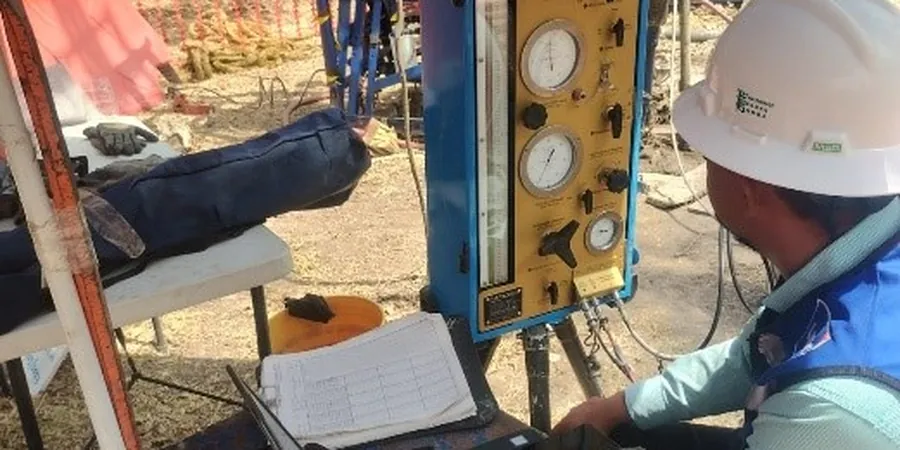
The PMT delivers in-situ lateral stress and stiffness — parameters no lab test can replicate — directly from the borehole.
Methodology and scope
- Ménard modulus (EM) for immediate settlement estimates.
- Limit pressure (pL) for bearing capacity of deep foundations.
- Pre-boring disturbance assessment via the pressure-volume curve shape.
Local considerations
Irvine sits atop the Santa Ana River floodplain, where groundwater levels can rise to within 2–3 m of the surface during wet years. If the PMT borehole is not properly maintained with drilling mud or casing, the probe may encounter borehole collapse or excessive soil relaxation, skewing the pressure-volume curve. Additionally, the presence of cemented caliche layers common in the Terrace deposits can cause erratic readings if pre-boring is not advanced with a rock coring bit. Our field crew always checks for standing water before testing and uses a slip coupling to avoid probe sticking in collapsing sands. In seismic zone 4, the PMT's limit pressure is also used to adjust the site class per ASCE 7-22, so accuracy is non-negotiable.
Applicable standards
ASTM D4719-20 (Standard Test Methods for Prebored Pressuremeter Testing in Soils), ASCE 7-22 (Minimum Design Loads — Site Class determination using PMT data), IBC 2021 (Section 1803 — Geotechnical Investigation requirements)
Associated technical services
Standard PMT for Bearing Capacity
Full pressuremeter profile from 1.5 m to 15 m depth, with EM and pL reports for shallow and deep foundation design. Includes borehole preparation with HQ coring and real-time volume-pressure recording.
Deep PMT for Pile Design
Extended testing to 30 m for drilled shaft projects. Provides pL profiles every 1.5 m and modulus decay curves for lateral load analysis. Used extensively on high-rise developments in the Irvine Business Complex.
PMT for Settlement Control
Focuses on EM values at foundation bearing depth to compute immediate settlement under service loads. Ideal for mat foundations on the Young Alluvium where differential settlement is a concern.
Typical parameters
Frequently asked questions
What is the cost of a Ménard pressuremeter test in Irvine?
The typical cost for a Ménard pressuremeter test (PMT) in Irvine ranges from US$1,140 to US$1,180 per test point, including borehole preparation and reporting. Volume discounts apply for projects requiring 10 or more tests.
How does the PMT differ from a standard triaxial test?
The PMT measures the soil's response in situ under lateral expansion, giving the Ménard modulus (EM) and limit pressure (pL). Triaxial tests use disturbed samples in the lab under controlled confining pressure. The PMT captures natural fabric, cementation, and in-situ stress that no lab sample can preserve.
What soil conditions in Irvine are best suited for PMT?
PMT works well in Irvine's Young Alluvium (silty sands, clayey sands) and older Terrace deposits (dense sands with gravel). It is less effective in very soft clays where the probe may cause excessive disturbance during insertion, and in hard cemented layers where pre-boring becomes difficult.