Irvine’s rapid growth from farmland to master-planned city brought massive earthwork operations. The flat alluvial plains and former citrus groves required extensive cut-and-fill grading to support residential tracts and business parks. For every compacted lift placed during that development, the field density test (sand cone method) became the standard tool to verify that soils met project specifications. It is a direct, reliable way to measure in-place density and percent compaction — essential when dealing with the silty sands and lean clays that dominate Irvine’s shallow subsurface. Earthwork contractors here still rely on it because it gives immediate results on site, without complex electronics.
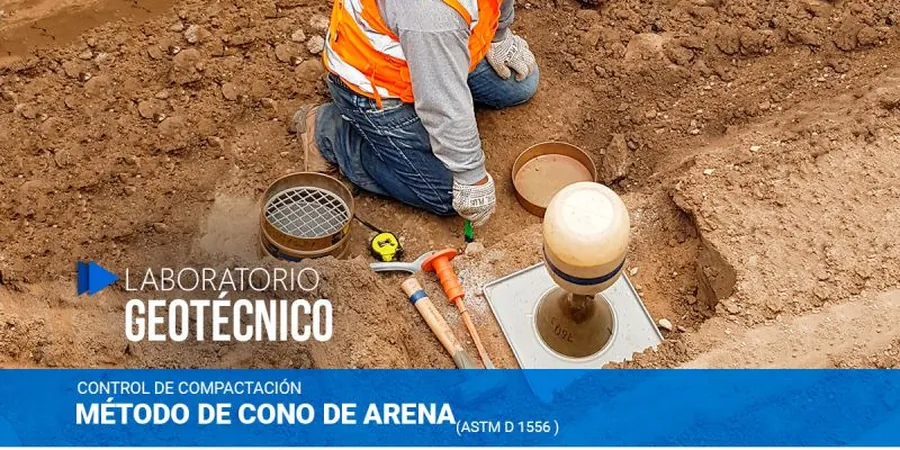
For fills and trenches in Irvine, the sand cone method gives a direct density check without radiation licensing — fast, field-validated compaction control.
Methodology and scope
- Direct measurement — no correlations or assumptions
- Works in moist or dry conditions
- Acceptable for granular and cohesive soils
- No radiation source, so no licensing delays
Local considerations
In Irvine, many times we see that compaction reports from sand cone tests are challenged because the reference Proctor curve was run on a different material than what was actually placed. That mismatch causes false rejections or false passes. Our lab verifies the material source before each test series, and we compare the sand cone result against the correct maximum dry density. Another common issue: shallow sampling on thin lifts that don’t represent the full layer thickness. We train field technicians to dig to the full lift depth and report lift thickness with every result. That small discipline prevents rework claims later.
Applicable standards
ASTM D1556 (Standard Test Method for Density and Unit Weight of Soil in Place by Sand-Cone Method), AASHTO T-191 (Density of Soil In-Place by the Sand-Cone Method), Caltrans MT 101 (Method of Test for Density of Soil In-Place by the Sand-Cone Method)
Associated technical services
Standard Sand Cone Test per ASTM D1556
Full in-place density determination on compacted fills, subgrades, and backfills. Our technicians excavate, weigh, dry, and compute percent compaction on site. Reports include moisture content and layer thickness. Ideal for residential slabs, commercial pads, and utility trench compaction in Irvine.
Nuclear Gauge Correlation & Backup Verification
When a nuclear density gauge is used for production testing, we perform sand cone tests at the same locations to establish a site-specific correlation. This ensures the gauge readings are accurate for the particular soil type and moisture conditions found in Irvine. Required by many city and county specifications.
Typical parameters
Frequently asked questions
What is the difference between sand cone and nuclear gauge density testing?
The sand cone method directly measures soil volume by filling the excavation hole with calibrated sand, then weighing the removed soil. It is a physical measurement with no radiation source. A nuclear gauge uses gamma radiation and requires licensing, daily calibrations, and correction for moisture. For Irvine projects with strict compaction specs, the sand cone remains the referee method when gauge results are disputed.
How many sand cone tests are needed for a typical Irvine residential lot?
For a standard single-family lot (approximately 6,000 sq ft), we typically run one test per 500 sq ft of compacted fill area, plus one per 100 linear feet of trench backfill. That means around 12 to 15 tests for the pad and another 5 to 8 for utility trenches. The City of Irvine’s building department may require additional tests near structures or at lift interfaces.
What is the typical cost range for a sand cone density test in Irvine?
For a single test point including field labor, drying, and a certified report, the cost ranges between US$100 and US$170. Volume discounts apply for projects requiring 20 or more test points. This price includes mobilization within Irvine city limits and same-day preliminary results.
Can the sand cone test be used on clay soils common in Irvine?
Yes, but with caution. In Irvine, clayey soils often have high natural moisture content, which can cause sand to stick to the hole walls and reduce measured volume, yielding an artificially high density. Our technicians dry the hole walls slightly and use a coarser sand when testing in plastic clays. We also cross-check with moisture-density curves from the appropriate Proctor test for that specific soil type.