In Irvine, the contrast between the weathered granitic slopes near Turtle Rock and the deeper alluvial deposits around the Irvine Business Complex tells a critical story about the city's subsurface. Each area demands a distinct approach to residual soil characterization. The decomposed granite on the hillsides behaves like a dense sand with some cohesion, while the alluvial fans in lower Irvine contain interbedded clays and silts that require careful evaluation of their collapse potential. That's why before any foundation design, we run a thorough campaign that starts with calicatas exploratorias to visually log the soil profile and assess weathering grades directly in the field.
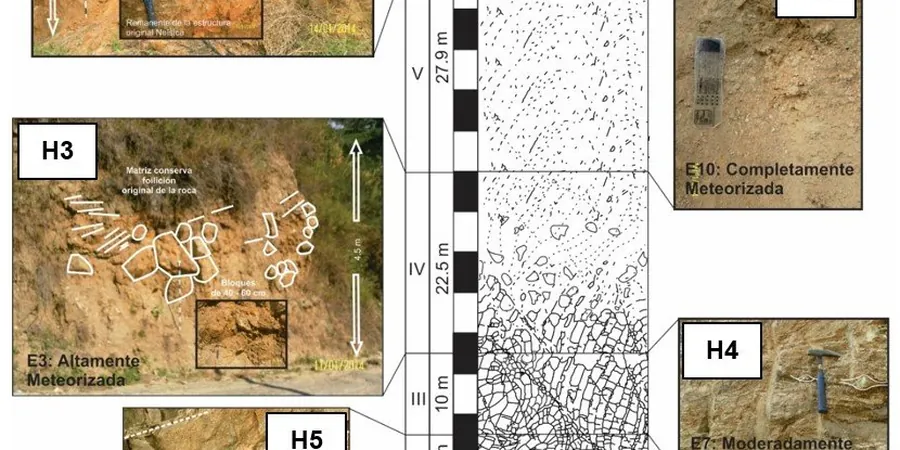
Residual soils in Irvine can mask high void ratios and low densities even when they appear competent, making proper characterization the single most important step in foundation design.
Methodology and scope
Local considerations
The Mediterranean climate of Irvine, with its long dry summers and intense winter rains, creates a pronounced wetting-drying cycle that can alter residual soil properties year after year. After a wet season, the near-surface weathered granite may lose suction and exhibit a sharp drop in apparent cohesion, leading to shallow slope failures along the Jeffrey Open Space Trail or in residential cuts. In the flatter areas near the San Diego Creek, the risk shifts to differential settlement when residual soils with variable weathering depths are loaded unevenly. Ignoring the collapse potential of these soils can result in cracked slabs and tilted hardscapes within the first few years of occupancy.
Applicable standards
ASTM D4318-17e1 — Standard Test Methods for Liquid Limit, Plastic Limit, and Plasticity Index of Soils, ASTM D6913-17 — Particle-Size Distribution (Gradation) of Soils Using Sieve Analysis, ASCE 7-22 — Minimum Design Loads and Associated Criteria for Buildings (Site Class Definitions), ASTM D2487-17 — Standard Practice for Classification of Soils for Engineering Purposes (Unified Soil Classification System)
Associated technical services
In-Situ Density and Moisture Content
Using sand cone and nuclear gauge methods, we measure the in-place dry density and moisture content of residual soils at multiple depths. These data are essential for compaction control and for estimating the void ratio of the weathered mass.
Collapse Potential Testing (Double Oedometer)
We perform double oedometer tests on undisturbed samples to quantify the collapse potential of Irvine's residual soils under wetting. This test is critical for projects located in areas with deep weathering profiles.
Shear Strength Testing (Triaxial and Direct Shear)
Consolidated-drained and consolidated-undrained triaxial tests, along with direct shear tests, provide the effective stress strength parameters (c', phi') needed for slope stability and foundation design in decomposed granite.
Typical parameters
Frequently asked questions
What is residual soil characterization and why is it important in Irvine?
Residual soil characterization refers to the process of identifying the engineering properties of soils formed in place by the chemical and physical weathering of the underlying bedrock. In Irvine, where the bedrock consists of granitic and volcanic rocks, the weathering profile can be deep and highly variable. Proper characterization helps engineers avoid problems like collapse settlement, slope instability, and bearing capacity failures.
How much does a residual soil characterization study cost in Irvine?
The cost typically ranges between US$780 and US$3,480, depending on the number of test pits, the depth of investigation, and the laboratory tests required. A basic study with two test pits and index testing is at the lower end, while a comprehensive campaign with SPT borings and triaxial testing approaches the higher end.
What is the difference between residual and transported soils in Irvine?
Residual soils are formed directly from the weathering of the underlying rock and retain the fabric and structure of the parent material, often exhibiting a gradational profile from soil to rock. Transported soils, like the alluvial deposits in the Irvine floodplain, are sediments moved by water or wind and have a different grain-size distribution and density. In Irvine, the distinction is critical because residual soils may have collapse potential, while transported soils are more prone to liquefaction.
Which ASTM standards apply to residual soil testing in Irvine?
Key standards include ASTM D4318 for Atterberg limits, ASTM D6913 for particle-size analysis, ASTM D2487 for classification, and ASTM D1586 for the Standard Penetration Test. For collapse potential, we follow ASTM D5333. All testing is performed under an ISO 17025-accredited quality system to ensure data reliability for engineering design.