The coastal plain around Irvine is underlain by deep alluvial deposits from the Santa Ana River, which create a complex seismic amplification effect during an earthquake. Unlike a stiff bedrock site, these sedimentary layers can trap and magnify seismic waves, increasing ground shaking intensity. That is why a site-specific seismic amplification analysis is essential before designing critical structures in Irvine. We combine downhole geophysics with shear wave velocity profiling to define the soil column's dynamic properties. This data feeds directly into response spectra that match local code requirements, rather than relying on generic default factors that may underestimate actual demands. Before running the analysis, we often recommend a complementary MASW survey to capture Vs30 values across the site, and a microtremor HVSR measurement to identify the fundamental site period.
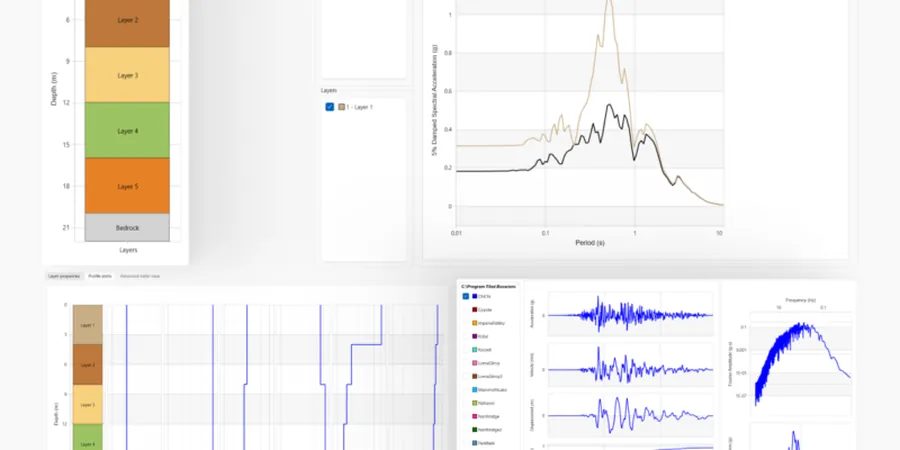
A site with Vs30 of 250 m/s can experience peak ground acceleration 1.8 times higher than a rock site at the same epicentral distance.
Methodology and scope
Local considerations
The greatest seismic risk in Irvine comes from the combination of deep soft soils and proximity to the Newport-Inglewood fault zone. A structure on the alluvial plain near the 405 freeway will feel far more intense shaking than one on the bedrock hills of Turtle Rock. Without a proper seismic amplification analysis, a design may underestimate spectral accelerations at mid-periods, which is exactly where many mid-rise buildings are vulnerable. We have seen cases where code-default amplification factors led to undersized shear walls in residential projects in the Woodbridge area, requiring costly retrofits later. This mismatch between assumed and actual ground response is completely preventable with site-specific analysis.
Applicable standards
ASCE 7-22 – Minimum Design Loads and Associated Criteria for Buildings, IBC 2021 – International Building Code, Chapter 16 Structural Design, ASTM D4428/D4428M – Crosshole Seismic Testing, NEHRP Recommended Seismic Provisions (FEMA P-1050)
Associated technical services
Ground Response Analysis (1D/2D)
Using SHAKE2000 and DEEPSOIL, we model shear wave propagation through the soil column. You get acceleration time histories, response spectra, and spectral accelerations at each layer. This is the core deliverable for structural engineers designing in Irvine's variable alluvium.
Liquefaction Triggering Evaluation
We combine SPT and CPT data with cyclic stress ratios from the amplification analysis to assess liquefaction potential. Output includes factor of safety profiles and post-liquefaction settlement estimates, critical for sites with shallow groundwater in Irvine.
Typical parameters
Frequently asked questions
What is seismic amplification analysis and why does Irvine need it?
Seismic amplification analysis models how soil layers modify earthquake waves as they travel from bedrock to the surface. Irvine sits on deep alluvial deposits that can amplify ground motion by a factor of 1.5 to 2.0 compared to rock sites. Without this analysis, a building may be designed for lower shaking than it will actually experience during a quake.
What is the typical cost range for a seismic amplification study in Irvine?
For a standard site with one borehole and downhole Vs measurement, the cost ranges between US$1,020 and US$1,850. This includes field work, laboratory testing, and a full report with response spectra. Larger sites or projects requiring multiple profiles may fall at the higher end of the range.
How is Vs30 measured for site classification under ASCE 7?
Vs30 is the average shear wave velocity in the top 30 meters. We measure it using downhole seismic testing per ASTM D4428, or with surface wave methods like MASW. The result determines the site class (A through F) in ASCE 7, which directly affects the design spectrum shape and amplitude.
Does the analysis consider the Newport-Inglewood fault?
Yes. We incorporate fault-specific ground motion predictions from the USGS NSHMP and the appropriate attenuation relationships for the Newport-Inglewood and San Joaquin Hills faults. The analysis uses scenario earthquakes with magnitudes between 6.5 and 7.0, which are the most probable sources for Irvine.
How long does a seismic amplification study take from field work to report?
A typical project takes three to four weeks. Field work and sample collection take one to two days, followed by laboratory testing and data processing. The final ground response report is delivered within two weeks after all data is collected.