A five-story apartment complex on Jamboree Road required fill placement over old channel deposits. We ran Standard Proctor to set the compaction target. Without that reference the contractor would have guessed at moisture and density. The site had silty sands with occasional clay lenses. We used ASTM D698 because the project didn't need the higher energy of Modified Proctor. That decision saved time and still met the 95 percent relative compaction specified. For deeper fills near the 405 corridor we often switch to Modified Proctor when the design requires higher bearing capacity. Before any Proctor we also perform a los de cimentacion analysis to confirm the foundation system matches the achieved density.
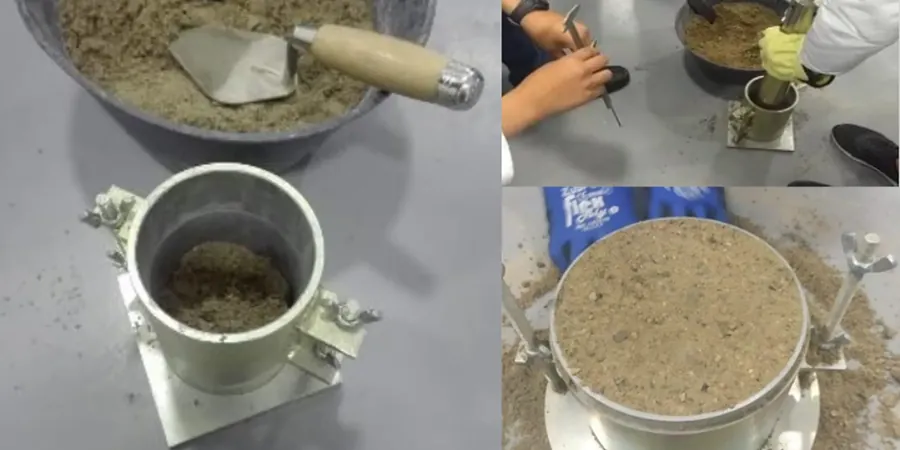
Standard Proctor for light fills; Modified Proctor for high-traffic subgrades. The energy difference is 12,400 vs 56,000 ft-lbf per cubic foot.
Methodology and scope
Local considerations
IBC 2021 requires compaction testing for all structural fills and pavements. Irvine's clayey silt layers can be moisture sensitive. If the Proctor curve is flat the soil is tolerant to water variation. If the curve is steep a small moisture change drops density by 3 to 5 pcf. That leads to settlement under slab-on-grade or pavement failure. We flag those soils and recommend a placa-de-carga to verify field modulus after compaction. The risk is real: a project near the Great Park had to recompact 6 feet of fill because the field density fell below 92 percent. The Proctor test prevented further rework.
Applicable standards
ASTM D698-12 (Standard Proctor), ASTM D1557-12 (Modified Proctor), IBC 2021 Chapter 18 (Excavation, Grading and Fill), AASHTO T-99 / T-180 (Standard and Modified)
Associated technical services
Standard Proctor (ASTM D698)
For light fills, residential pads, and low-traffic subgrades. Uses 12,400 ft-lbf/ft³. Three layers, 25 blows per layer with a 5.5-lb hammer.
Modified Proctor (ASTM D1557)
For heavy fills, airport aprons, and high-traffic pavements. Uses 56,000 ft-lbf/ft³. Five layers, 25 blows per layer with a 10-lb hammer.
Field Density Verification
Sand cone or nuclear gauge tests to compare field density against Proctor curves. Meets ASTM D1556 or ASTM D6938.
Moisture-Density Curve Analysis
Full curve plotting with five to six points. Includes zero-air-voids line and saturation degree check.
Typical parameters
Frequently asked questions
What is the difference between Standard and Modified Proctor?
Standard Proctor uses 12,400 ft-lbf/ft³ of compaction energy; Modified Proctor uses 56,000 ft-lbf/ft³. Modified is used for high-traffic pavements or deep fills where greater density is required. Choose based on the project’s design specifications.
How much does a Proctor test cost in Irvine?
A Standard Proctor test in Irvine typically costs between US$110 and US$200 per sample. Modified Proctor is slightly higher due to more layers and time. Volume discounts are available for multiple samples on the same project.
Do I need a Proctor test for a small retaining wall in Irvine?
Yes, if the wall requires backfill compaction. IBC 2021 mandates compaction control for all structural fills. Without a Proctor curve you cannot verify relative compaction. For walls under 4 feet, Standard Proctor usually suffices.
How long does it take to get Proctor test results?
We deliver results within 48 hours for Standard Proctor and 72 hours for Modified Proctor. The timeline depends on the number of points needed for a full curve. Rush service is available at no extra charge for Irvine projects.