Irvine grew fast from the 1960s Master Plan, turning orange groves into a master-planned city of over 300,000 people. That agricultural past left a legacy of deep alluvial soils, often with interbedded clay layers that challenge foundation design. For any heavy structure here, from medical towers to five-story parking garages, a raft or mat foundation spreads the load over a larger footprint, reducing contact pressure on these variable deposits. We have designed dozens of mat slabs in Irvine, combining plate load tests with seismic site response analysis. Before specifying the slab thickness and reinforcement, we always run a MASW Vs30 survey to capture shear-wave velocity profiles and confirm the NEHRP site class.
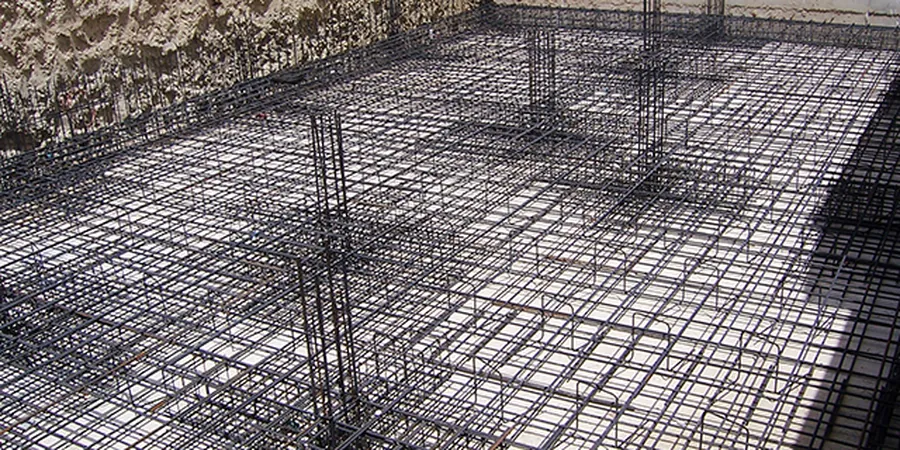
A properly designed mat foundation in Irvine's alluvial soils can limit differential settlement to less than 20 mm, even under column loads exceeding 2,000 kN.
Methodology and scope
Local considerations
We saw a mid-rise residential project near the I-5 and Jamboree where the geotechnical report missed a 1.5-meter soft clay lens at 4 meters depth. The mat foundation was designed for a uniform bearing pressure of 180 kPa, but after backfill the corner column settled 35 mm in two months. The contractor had to install six micropiles to underpin the mat. That is why we always pair raft foundation design with a detailed CPT sounding profile when the geology shows lateral variation. In Irvine, the shallow groundwater at 3–6 meters can also soften clay layers if dewatering is not maintained during excavation.
Applicable standards
ASCE 7-22 (seismic loads, site class D/E), ACI 318-19 (reinforced concrete design, punching shear), ASTM D1195/D1195-09 (plate load test for modulus of subgrade)
Associated technical services
Detailed Geotechnical Investigation
Boreholes to 15 meters, SPT every 1.5 meters, undisturbed sampling of clay layers, and laboratory testing (triaxial CU, consolidation, moisture content) to define design parameters.
Mat Foundation Structural Design
Finite-element modeling (SAFE or STAAD Foundation) for mat thickness, reinforcement, and deflection control under combined dead, live, and seismic loads per IBC 2021.
Construction QA/QC and Verification
Field monitoring of subgrade preparation, plate load tests after excavation, and concrete testing (slump, cylinders) to ensure the mat performs as designed.
Typical parameters
Frequently asked questions
What is the typical cost range for a raft foundation design in Irvine?
For a typical commercial building, the geotechnical investigation and structural design together range between US$1.180 and US$4.160, depending on the number of borings and complexity of the soil profile. Actual cost is quoted after reviewing the project scope.
When is a mat foundation better than spread footings?
A mat foundation is preferred when column loads are high, soil bearing capacity is low (below 150 kPa), or when differential settlement must be minimized. In Irvine's alluvial soils with variable clay layers, mats often cost less than many deep foundations.
Does Irvine's seismic hazard affect mat foundation design?
Yes – Irvine sits in Seismic Zone 4 (ASCE 7 site class D typically). The mat must resist overturning from lateral seismic forces and accommodate potential liquefaction-induced settlement in loose saturated sands. We always include a site-specific response spectrum analysis.
How deep do you excavate for a mat foundation in Irvine?
Typically 1.2 to 2.0 meters below existing grade, depending on the depth of the desiccated crust and frost depth (minor in Southern California). The excavation bottom must be inspected and proof-rolled to verify uniform bearing.