The alluvial soils of the Irvine basin present a unique challenge for foundation engineers. Seasonal moisture from the Santa Ana River and underlying marine deposits create variable ground conditions across the city. Deep soil mixing design addresses these challenges by mechanically blending cementitious binders with native soils to improve strength and reduce permeability. In Irvine's seismic environment, this technique is critical for mitigating liquefaction risk in loose sands. Our team applies ASCE 7 and IBC standards to every deep soil mixing design, ensuring compliance with local building codes. Before the mixing operation begins, we recommend a resistivity survey to map subsurface variability and optimize binder dosage.
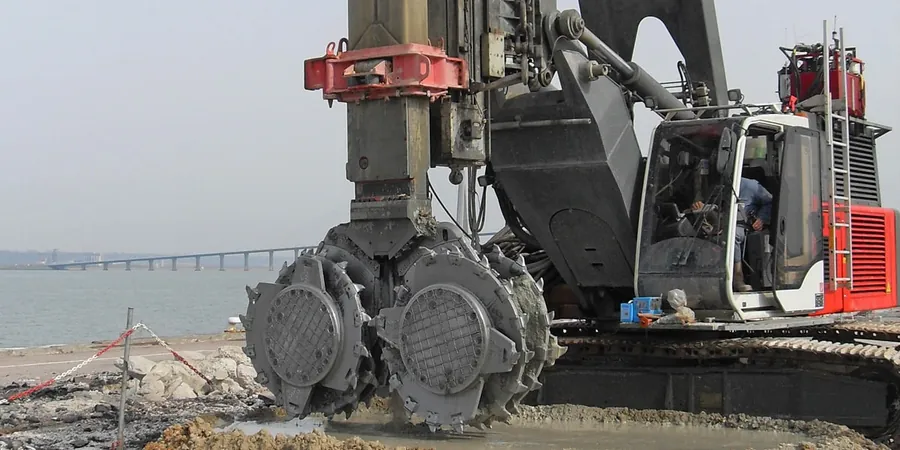
Deep soil mixing design in Irvine demands integration of seismic hazard analysis with site-specific soil blending ratios to achieve reliable ground improvement.
Methodology and scope
Local considerations
A four-story mixed-use building in the Irvine Business Complex required deep soil mixing design to treat a 6-meter-deep layer of loose silty sand. The original foundation plan called for driven piles, but vibration limits from nearby existing structures forced a change. Without proper mixing, the column-to-column overlap could leave untreated seams. In high seismic zones like Irvine, those gaps become failure planes during a design earthquake. Our team used on-site quality control with continuous binder flow monitoring and core sampling at 7 and 28 days to verify uniformity.
Applicable standards
ASCE 7-22 Minimum Design Loads and Associated Criteria for Buildings and Other Structures, IBC 2021 Chapter 18 Soils and Foundations, ASTM D1586-18 Standard Test Method for Standard Penetration Test (SPT), FHWA-HRT-17-070 Deep Mixing for Embankment and Foundation Support
Associated technical services
Design-Build Columns for Liquefaction Mitigation
We provide complete deep soil mixing design for grid or block patterns to densify loose sands and reduce pore pressure buildup during seismic events. Our designs include binder selection, column spacing optimization, and strength verification.
Earth Retention and Shoring Support Walls
Deep soil mixing columns arranged in tangent or secant configurations create stiff gravity walls for excavations. We design the mixing parameters to achieve the required bending moment capacity and water cutoff for temporary or permanent shoring in Irvine's urban environment.
Typical parameters
Frequently asked questions
What is the typical depth range for deep soil mixing design in Irvine?
Most projects in Irvine require treatment depths between 6 m and 18 m due to the shallow groundwater table and the presence of liquefiable layers. Deeper columns up to 30 m are feasible with specialized equipment for high-rise foundations near the 405 corridor.
How does seismic design affect deep soil mixing design parameters?
Irvine sits in Seismic Design Category D per IBC 2021. The deep soil mixing design must account for peak ground acceleration of 0.4g to 0.6g. We increase binder content and column overlap to ensure the treated mass behaves as a monolithic block during shaking. vs30/" data-interlink="1">Shear wave velocity targets often exceed 250 m/s after treatment.
What is the cost range for a deep soil mixing design in Irvine?
The cost for deep soil mixing design services in Irvine typically ranges between US$1,500 and US$6,180 depending on the number of columns, depth, and required testing. This covers binder mix design, column layout, settlement analysis, and quality control documentation.