For projects in Irvine, the ASCE 7-16 standard requires determination of the site class based on average vs30/" data-interlink="1">shear wave velocity (VS30) to 30 m depth, but when a full active seismic array is impractical or budget-constrained, the HVSR microtremor survey (Nakamura method) offers a reliable passive alternative. This technique records ambient seismic noise with a single three-component seismometer to identify the fundamental resonance frequency of the soil column, which correlates with the thickness and stiffness of sedimentary layers. In Irvine, where alluvial fans from the San Joaquin Hills and Santa Ana River deposits create complex soil profiles, a single-station HVSR measurement can quickly indicate whether the site sits on stiff or soft ground before committing to a full MASW vs30 array or a microzonificación sísmica study. Our laboratory follows the SESAME project guidelines and SESAME criteria for data reliability, ensuring that the H/V ratio peaks are meaningful and not artifacts of wind or traffic noise.
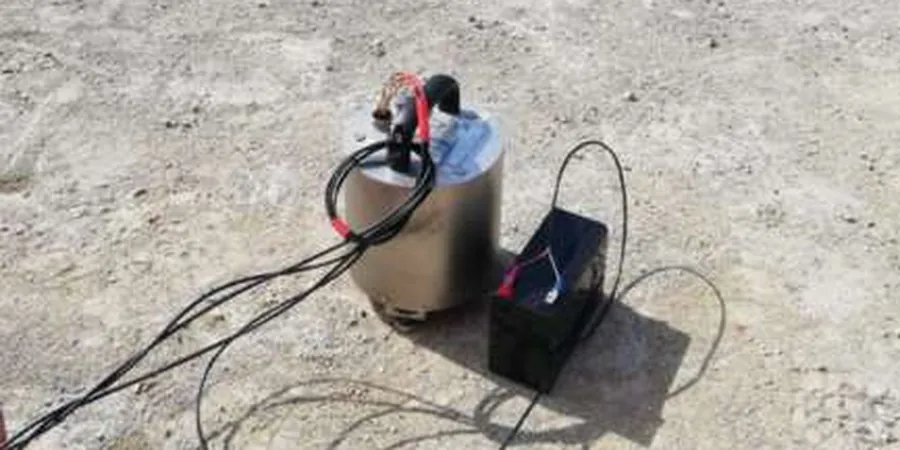
A clear H/V peak between 0.5 and 2 Hz in Irvine typically indicates a deep alluvial basin that can amplify long-period ground motions.
Methodology and scope
Local considerations
The geology beneath Irvine consists primarily of Quaternary alluvium deposited by the Santa Ana River, with thicknesses reaching over 300 m near the basin center. This deep, soft sedimentary fill creates a classic basin effect: ground motions from distant earthquakes are amplified at frequencies corresponding to the fundamental resonance of the soil column. In our experience, an HVSR microtremor survey in Irvine often shows a dominant peak between 0.5 and 1.5 Hz, which corresponds to a site period of 0.7 to 2 seconds. That is exactly the range that can cause resonance in mid-rise buildings of 5 to 15 stories, potentially doubling the seismic demand on the structure if the building's natural period aligns with the site's fundamental period. Without this measurement, a project might incorrectly classify the site as Site Class C (very dense soil) when the actual behavior is closer to Site Class D (stiff soil) under ASCE 7.
Applicable standards
ASCE 7-16 Section 11.4 (Site Classification), SESAME Project Guidelines (2004) – H/V technique, IBC 2021 Chapter 16 – Seismic Design Criteria, ASTM D7400 – Standard Test Method for Downhole Seismic Testing
Associated technical services
Single-Station HVSR Survey
A rapid reconnaissance using one tromometer deployed at 1 to 3 stations per site. Ideal for early feasibility studies and quick site class screening. Each station includes 30 minutes of recording, real-time QC, and a report with the H/V curve and interpreted fundamental frequency.
Multi-Station HVSR Array
A denser network of 4 to 8 stations covering the entire property footprint. Processed with spatial interpolation to produce a resonance frequency map. Useful for differentiating soil conditions across a large parcel in Irvine, such as a master-planned community or corporate campus.
Typical parameters
Frequently asked questions
How does the HVSR microtremor survey work in Irvine?
A three-component seismometer records ambient vibrations (wind, traffic, microseisms) for 20-30 minutes. The software computes the spectral ratio of horizontal to vertical motion, and a clear peak indicates the fundamental resonance frequency of the underlying soil column.
What is the typical cost of an HVSR microtremor survey in Irvine?
The cost for a single-station survey in Irvine ranges between US$1,320 and US$2,230, depending on the number of stations and the required reporting detail. Multi-station arrays are priced per additional station.
Can HVSR replace a MASW or SPT investigation?
No, HVSR provides the resonance frequency but not the vs30/" data-interlink="1">shear wave velocity profile with depth. It is best used as a screening tool before deciding whether to perform a more detailed active survey like MASW or a borehole-based SPT.
How long does an HVSR survey take in Irvine?
A single station takes about 30 minutes of field time, plus travel and setup. A 5-station survey can be completed in a single day. Data processing and reporting typically require 2-3 business days.
What does the HVSR report include?
The report includes the raw H/V curve for each station, the interpreted fundamental frequency (f0) and amplitude, the reliability criteria (SESAME compliance), and a recommendation for site class according to ASCE 7.