In Irvine, geophysical investigations adapt to the complex alluvial and sedimentary geology of Orange County, shaped by the Santa Ana River and nearby fault systems like the Newport-Inglewood zone. Our approach addresses site-specific challenges—from assessing basin-edge effects to complying with CBC/ASCE 7-22 requirements for seismic site class. We routinely deploy MASW / VS30 profiling to determine shear wave velocity to 30 meters depth, a critical parameter for structural design. For sites with limited access or ambient noise constraints, the HVSR microtremor survey (Nakamura method) provides a rapid, non-invasive alternative to estimate fundamental site period and layering.
These methods support a broad range of projects, from mid-rise commercial developments in the Irvine Business Complex to infrastructure and public-school modernizations requiring precise seismic hazard evaluation. Where stratigraphic detail or depth-to-bedrock is needed, seismic tomography complements velocity profiles by imaging subsurface geometry. The resulting data directly informs foundation design, liquefaction assessments, and ground-improvement strategies across the city’s engineered fill and older alluvial terraces.
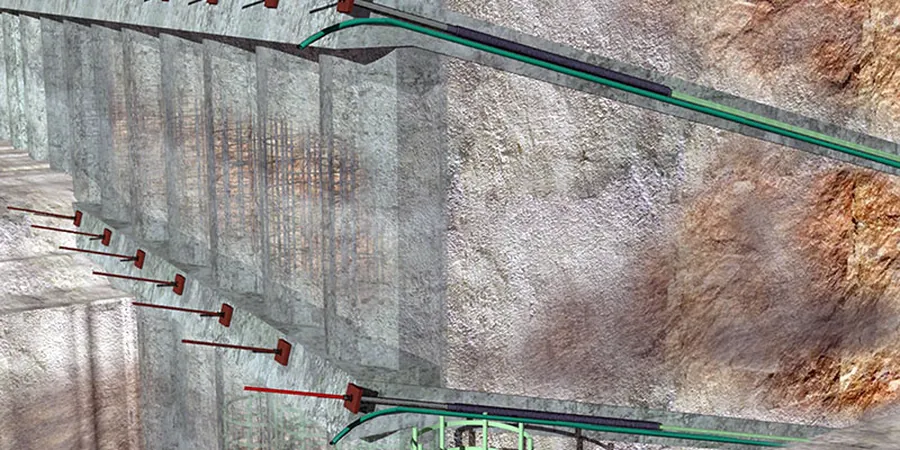
Anchor capacity in Irvine depends on the bond between grout and alluvium. Design must match the actual soil stiffness and groundwater level.
Methodology and scope
Local considerations
In Irvine, many contractors assume the alluvial soils provide uniform bond. That is rarely true. We see interbedded layers of loose sand and stiff clay within the same borehole. If the anchor bond zone intercepts a loose sand layer, the pullout capacity drops significantly. Seismic shaking also increases the risk of anchor head displacement in the upper 3 meters. We always specify a corrosion protection class for anchors in the vadose zone. That extra step prevents long-term degradation in the oxygen-rich environment above the water table.
Explanatory video
Applicable standards
ASCE 7-22 (Minimum Design Loads for Buildings and Other Structures), IBC 2021 (International Building Code, Chapter 18), PTI DC35.1-14 (Recommendations for Prestressed Rock and Soil Anchors), ASTM D1586-18 (Standard Test Method for Standard Penetration Test)
Associated technical services
Temporary Tieback Anchors
Design and installation of temporary anchors for shoring systems. We size the bond length for the actual soil conditions and verify capacity through proof testing on the first 3 anchors.
Permanent Ground Anchors
Corrosion-protected anchor systems for retaining walls and bridge abutments. Our design includes double corrosion protection and meets PTI DC35.1 requirements for service life exceeding 75 years.
Anchor Load Testing
Performance and proof testing per ASTM E2396. We provide real-time load-displacement data and certify the anchor capacity for the engineer of record.
Typical parameters
Frequently asked questions
What is the difference between active and passive anchors?
Active anchors are prestressed after installation. The tendon is tensioned to a predetermined load, which compresses the soil mass and reduces deformation. Passive anchors are not prestressed. They only resist load when the structure starts to move. Active anchors are common for tieback walls in Irvine excavations. Passive anchors are used in soil nailing and slope stabilization where some movement is acceptable.
How much does anchor design cost in Irvine?
The typical cost for a complete anchor design package in Irvine ranges from US$990 to US$4,340. This includes bond length calculations, corrosion protection sizing, and shop drawings. The final price depends on the number of anchors and the complexity of the soil profile. For small retaining walls with 10 anchors, the lower end applies. For large shoring systems with 50 anchors, the upper end is more realistic.
What soil conditions affect anchor capacity in Irvine?
The alluvial soils in Irvine vary laterally and vertically. Loose silty sands give low bond stress, around 40 kPa. Stiff clays from the older terrace deposits can reach 80 kPa. Groundwater also reduces the effective stress in the bond zone. We always review the SPT N-values from the geotechnical report and adjust the design for the lowest expected values in the anchor horizon.