Road subgrade design in Irvine must account for the city's alluvial fan deposits and a Mediterranean climate with dry summers and episodic winter rains. The 2019 California Building Code, referencing ASCE 7-16, sets site class criteria based on VS30 measurements, which directly influence subgrade reaction modulus for pavement design. Our team evaluates these parameters using in-situ testing and laboratory classification per ASTM D2487. We integrate site-specific data to define the design CBR and resilient modulus, ensuring that the subgrade layer supports the intended traffic loads without excessive deformation. Before finalizing the design, we often recommend a complementary CBR test to verify the in-situ bearing capacity under soaked conditions, as Irvine's clayey sands can lose strength when saturated during the rainy season.
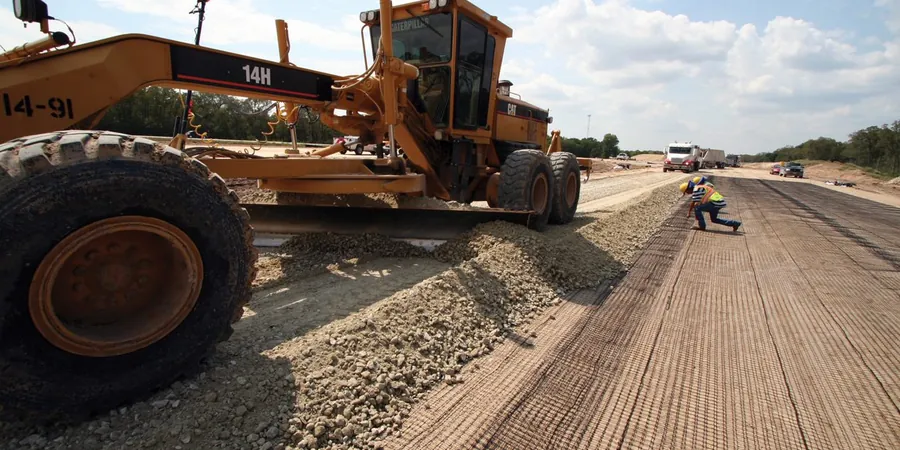
Irvine's alluvial soils require site-specific subgrade modulus values; a generic design assumption can lead to premature pavement failure.
Methodology and scope
- Field DCP soundings every 50 to 100 feet along the alignment
- In-situ moisture and density checks using the nuclear gauge
- Classification of soils by the Unified Soil Classification System (USCS)
Local considerations
Irvine sits within the active Peninsular Ranges seismic zone, with the nearby San Joaquin Hills fault capable of producing a M6.5-7.0 event. During strong shaking, loose granular subgrade soils can densify and settle differentially, while saturated clayey layers may lose shear strength. The 1971 San Fernando and 1994 Northridge earthquakes demonstrated how subgrade failure beneath roadways leads to longitudinal cracking and edge settlement. Our road subgrade design mitigates these risks by specifying a minimum compaction of 95% relative density per ASTM D1557 and recommending geogrid reinforcement where liquefaction potential is identified through the NCEER SPT-based method.
Applicable standards
ASCE 7-16 (Site Classification), Caltrans Highway Design Manual (Chapter 630), ASTM D1883-16 (CBR Test), AASHTO T-307 (Resilient Modulus), IBC 2021 (Section 1803 Geotechnical Investigations)
Associated technical services
Subgrade Exploration & Laboratory Testing
Boreholes, DCP profiles, and laboratory classification including Atterberg limits, sieve analysis, and Proctor compaction. We provide a detailed subgrade profile with CBR and modulus recommendations for pavement design.
Pavement Section Design & Verification
Using AASHTO 1993 or Mechanistic-Empirical (MEPDG) methods, we design the pavement structure (base, subbase, subgrade). We verify performance through plate load tests and FWD measurements after construction.
Typical parameters
Frequently asked questions
What is the difference between CBR and resilient modulus for subgrade design?
CBR (California Bearing Ratio) is a static penetration test that indicates the strength of subgrade under controlled conditions, while resilient modulus (Mr) measures the elastic stiffness under repeated loading, simulating traffic. Mr is the primary input for modern mechanistic-empirical pavement design. In Irvine, we typically correlate CBR to Mr using the relationship Mr (psi) = 2555 x CBR^0.64 for fine-grained soils.
How much does road subgrade design cost in Irvine?
The cost typically ranges between US$1.090 and US$2.760 for a standard residential or light commercial project, depending on the number of test pits, laboratory tests, and the complexity of the pavement section. Larger arterial road projects with multiple alignments will require a custom proposal.
Does Irvine's alluvial soil require special treatment for subgrade?
Yes, Irvine's alluvial deposits often contain clay lenses with moderate swelling potential and variable density. We recommend lime or cement stabilization when the plasticity index exceeds 15, or when the soaked CBR falls below 3%. Geogrid reinforcement is also effective for bridging soft spots.
What compaction standard is used for subgrade in Irvine?
Caltrans and most Orange County jurisdictions require subgrade compaction to at least 95% of the maximum dry density per ASTM D698 (Standard Proctor) for the top 12 inches, and 90% for deeper layers. For cohesive soils, moisture control within ±2% of optimum is critical to avoid post-construction settlement.
How does the seismic site class affect subgrade design in Irvine?
Irvine is primarily underlain by Site Class C (very dense soil) or D (stiff soil) per ASCE 7-16. Site Class D requires a seismic coefficient that increases the design base shear. For pavement design, this means the subgrade must accommodate potential differential movement during an earthquake, often addressed by using flexible pavements that can tolerate some deformation.