In Irvine, we often see projects where the geotechnical report relies solely on SPT blow counts for seismic design, yet the shear wave velocity profile tells a very different story about the soil stiffness. For a recent multifamily development near the 405 freeway, we performed MASW surveys to map the VS30 profile across a 10-acre site, revealing a distinct transition from stiff alluvium at the surface to softer Pleistocene deposits at depth. That data directly informed the site class assignment per ASCE 7, avoiding an overly conservative design that would have added unnecessary foundation costs. Complementing this with a microtremor HVSR survey helped confirm the resonant frequency of the soil column, giving the structural team confidence in their dynamic analysis.
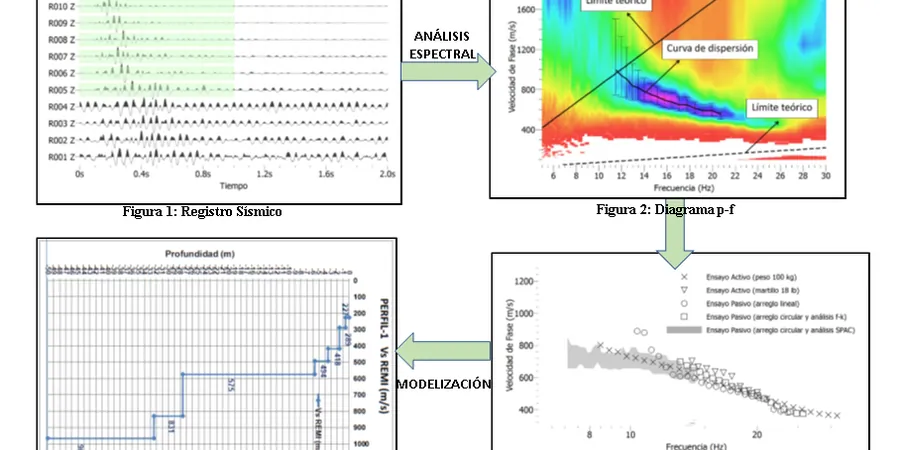
A single MASW profile can replace three or four borehole-based shear wave velocity measurements, reducing field time by 60% while delivering continuous depth coverage.
Methodology and scope
Local considerations
The primary geological risk in Irvine is the presence of soft Holocene alluvium and artificial fill overlying stiffer older deposits, which can create a sharp velocity contrast that amplifies ground motion. In the Great Park area, we have mapped VS30 values as low as 220 m/s (Site Class D) in the upper 10 meters due to undocumented fill from agricultural grading. If a designer assumes a stiffer Site Class C based on blow counts alone, the spectral acceleration could be underestimated by 30% or more, leading to an under-designed lateral system. Early MASW screening identifies these velocity inversions, allowing the structural team to incorporate site-specific response spectra rather than relying on generic code maps.
Applicable standards
ASTM D4428 (MASW standard test method), ASCE 7-22 (Minimum Design Loads, site class provisions), NEHRP Recommended Seismic Provisions (VS30 site classification), IBC 2021 (Chapter 16, seismic design requirements)
Associated technical services
2D MASW Profiling for Large Sites
We deploy parallel lines across a site to generate a 2D shear wave velocity cross-section, ideal for detecting lateral variability in soil stiffness. This is particularly useful for master-planned communities in Irvine where fill thickness varies dramatically over short distances, allowing engineers to zone foundations accordingly.
VS30 Certification for Seismic Reports
For projects requiring a NEHRP site class designation, we provide a certified VS30 value with a full uncertainty analysis. The report includes the dispersion curve, inversion model, and a comparison to nearby borehole data, satisfying the peer-review requirements typical of Orange County building departments.
Typical parameters
Frequently asked questions
How does MASW compare to downhole or crosshole seismic methods for VS30 determination?
MASW is non-invasive and does not require boreholes, making it faster and cheaper for preliminary screening. Downhole methods provide higher vertical resolution at specific locations but require drilling. For large sites in Irvine, MASW is often the first step, followed by targeted downhole testing where anomalies are identified.
What VS30 values are typical for Irvine soils and how do they affect site class?
In the central Irvine area, VS30 values typically range from 250 to 350 m/s, corresponding to NEHRP Site Class D. Areas near the Santa Ana River may drop below 250 m/s (Site Class E) where soft alluvium is deeper. These values shift the design spectrum to higher accelerations at longer periods, which is critical for mid-rise buildings with fundamental periods around 0.5 to 1.0 seconds.
What is the typical cost range for a MASW survey in Irvine?
For a standard single-line MASW survey with one profile in Irvine, the cost ranges from US$1,470 to US$3,180, depending on site access, array length, and the number of profiles required. Multi-line 2D surveys or projects with difficult access (e.g., heavily vegetated slopes) fall at the higher end of that range.