Irvine sits on a mix of alluvial soils and weathered sedimentary bedrock, with groundwater tables that vary significantly between the coastal plain and the foothills near the Santa Ana Mountains. This geological diversity means slope stability in Irvine depends heavily on localized shear strength parameters and drainage conditions. Our approach combines field investigations, including the MASW-Vs30 survey to map stiffness contrasts, with limit equilibrium modeling to factor in seismic loads from nearby fault systems. We target a minimum factor of safety of 1.5 under static conditions and 1.1 under pseudo-static seismic loading per ASCE 7, adjusting for the site-specific ground motion amplification expected in Orange County.
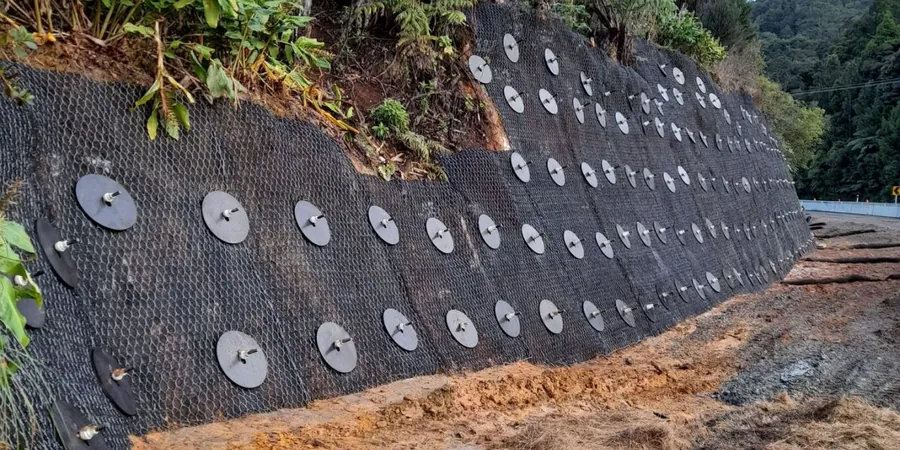
We target a minimum factor of safety of 1.5 static and 1.1 pseudo-static, adjusting for the ground motion amplification typical of Orange County hillsides.
Methodology and scope
- We install horizontal drains or trench drains keyed into stable strata
- We size soil nail patterns based on pullout resistance from field tests
- We specify vegetated riprap or geocell mats for face erosion control
Local considerations
A recent cut slope in the Orchard Hills area of Irvine failed during a December rainstorm when the contractor excavated 8 m high without temporary shoring. The failure plane ran along a thin clay seam that had zero cohesion when saturated. That same seam had been logged during the initial geotechnical investigation but was not highlighted in the construction documents. The result was a $200,000 emergency repair and a four-week schedule delay. Our slope stabilization design reviews always flag these subtle weak layers, recommend drainage ahead of excavation, and specify staged benching to control unloading rates.
Applicable standards
ASCE 7-22 Minimum Design Loads (seismic slope stability), IBC 2021 Chapter 18 (excavation, grading, foundations), FHWA-NHI-05-089 Soil Nail Walls Reference Manual, ASTM D6706-01 (pullout testing for soil nails)
Associated technical services
Cut Slope Design & Shoring Plans
Design of temporary and permanent cut slopes up to 15 m high, including soil nail walls, soldier pile and lagging, and tieback anchors. Deliverables include cross-sections, drainage details, and construction sequencing notes.
Fill Slope Reinforcement & Drainage Design
Stabilization of existing and proposed fill slopes using geogrid-reinforced soil, rock buttresses, or lightweight fill. We design underdrain systems, toe berms, and surface water diversion to prevent long-term saturation.
Typical parameters
Frequently asked questions
What factor of safety is required for slope stabilization design in Irvine?
For permanent slopes, we design to a static factor of safety of 1.5 per IBC and ASCE 7. For seismic conditions, we use a pseudo-static factor of safety of 1.1 with a horizontal seismic coefficient between 0.15 and 0.25, depending on site soil class and distance to active faults.
How much does a slope stabilization design study in Irvine typically cost?
A typical study for a 10–15 m high slope in Irvine ranges from US$1,510 to US$6,750. This includes field exploration, laboratory testing, limit equilibrium analysis, and a report with construction drawings. The variation depends on slope length, access, and the number of design alternatives evaluated.
What soil conditions in Irvine cause the most slope stability problems?
The most problematic conditions are thin clay or siltstone seams at shallow depth, which lose cohesion when saturated. We also see failures in poorly compacted fill slopes built on untreated native soil. Proper drainage and staged construction are key to avoiding these issues.