Irvine sits on a mix of alluvial terraces and ancient marine sediments, which means soft clay layers are common below the topsoil. After a wet winter, these clay zones retain moisture and behave like a plastic mass — exactly the scenario where the field vane shear test (VST) delivers the most reliable undrained shear strength data. Instead of guessing from blow counts alone, we spin the vane directly into the soft stratum and read the peak and remolded torque. For projects near the San Joaquin Hills or along the 405 corridor, combining VST with a resistividad eléctrica SEV helps map the transition from stiff crust to soft clay before we even mobilize the rig.
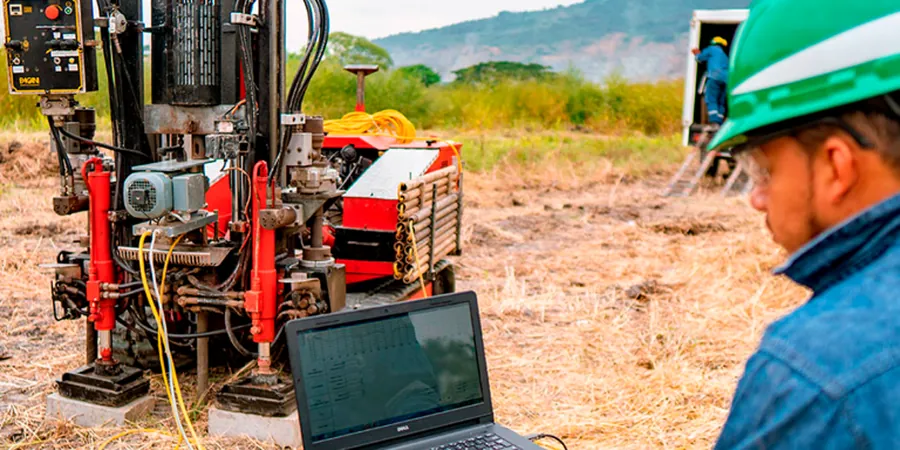
In soft clays, the field vane shear test gives you the real undrained strength — not a correlation from a blow count that was never designed for clay.
Methodology and scope
- We push the four-bladed vane to the target depth using a drill rig or CPT push system.
- Rotation at a constant rate of 0.1°/s until failure, recording peak torque.
- We then rotate rapidly for 10 revolutions to remold the soil and measure the remolded strength.
- Sensitivity ratio (peak / remolded) tells us whether this clay will lose strength under construction vibration.
Local considerations
Irvine recorded a population of over 300,000 in the 2023 census, and much of the recent development has pushed into former marshlands near the Upper Newport Bay. These soft estuarine deposits can have undrained shear strengths below 15 kPa — a value that is impossible to measure reliably with a pocket penetrometer or SPT. If the geotechnical report for a new mixed-use project near the Great Park overlooks a vane shear test profile, the foundation design may underestimate settlement and bearing failure in the underlying clay. We have seen post-construction differential settlements of up to 8 cm in buildings where the soft clay was not properly characterized.
Applicable standards
ASTM D2573-15: Standard Test Method for Field Vane Shear Test in Saturated Fine-Grained Soils, IBC 2021 Section 1806: Presumptive Load-Bearing Values — requires in-situ shear strength for soft clays, ASCE 7-22 Chapter 11: Seismic Site Class — VST data supports site class evaluation for liquefaction screening
Associated technical services
Standard Vane Shear Test (VST) – Single Location
One vane shear test at a single depth. Includes peak and remolded torque readings, sensitivity ratio, and Bjerrum-corrected undrained shear strength. Ideal for small foundations, utility corridors, or preliminary site assessments. Report sent within 48 hours.
Multi-Depth VST Profile – Continuous Log
Vane shear tests at 1.5 m intervals from 3 m to 25 m depth. Provides a full shear strength profile with correction for plasticity. Recommended for large commercial pads, retaining walls, or any structure sensitive to differential settlement. Includes comparison with nearby SPT or CPT data if available.
Typical parameters
Frequently asked questions
What is the difference between the field vane shear test and a laboratory triaxial test?
The vane shear test measures the undrained shear strength in-situ, without disturbing the soil fabric, whereas a triaxial test requires an undisturbed sample that inevitably suffers stress relief and disturbance during sampling and transport. For soft sensitive clays, the vane test often yields a more representative strength for short-term stability analysis.
How much does a field vane shear test cost in Irvine?
A single-depth VST typically costs between US$650 and US$1,090 depending on mobilization distance and site access. A multi-depth profile (6 to 10 readings) runs from US$1,200 to US$1,690. These ranges include the technician, equipment, and a certified report.
At what depth can the vane shear test be performed?
We routinely perform VST from 0.5 m down to 25 m using a drill rig or CPT push system. The practical limit depends on rod stiffness and the risk of rod buckling in very soft soils. For depths beyond 25 m, we recommend combining VST with a CPT sounding.
Can the vane shear test be used in sandy soils?
No. The vane shear test is only valid in saturated fine-grained soils (clays and silts) where the undrained condition is applicable. In sands, the test produces unreliable results because the soil drains too quickly. For sandy layers, we use SPT or CPT instead.
How does the Bjerrum correction factor affect the vane shear result?
Bjerrum (1972) showed that the vane shear test overestimates the undrained shear strength in high-plasticity clays. We apply a correction factor μ that ranges from 0.6 for very plastic clays (PI > 80) to 1.0 for low-plasticity clays (PI < 20). The corrected value is the one used in bearing capacity and stability calculations.