A common mistake we see from builders in Irvine is assuming that the shallow alluvial soils near the Santa Ana River behave the same as the older terrace deposits up by the Tustin foothills. That assumption can lead to shear failure or excessive differential settlement during a seismic event. Proper seismic foundation design in Irvine must account for the city's varied subsurface conditions, from loose sand layers prone to liquefaction to stiff clays that amplify ground motion. We start every project with a site-specific evaluation rather than relying on generic geotechnical reports.
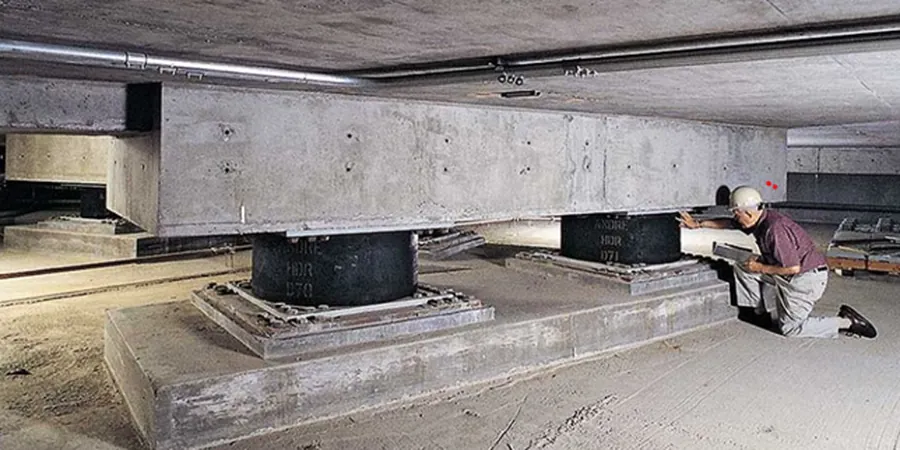
Seismic foundation design in Irvine must account for the sharp contrast between Santiago Formation bedrock and young alluvial deposits, or risk costly structural damage.
Methodology and scope
Local considerations
When we deploy the CPT rig in Irvine, we often see the cone tip resistance drop sharply below 5 MPa at depths of 10 to 20 feet — classic loose sand behavior that triggers liquefaction concerns. If your seismic foundation design in Irvine ignores these low-resistance layers, you risk bearing failure or lateral spreading during a magnitude 6.8 event on the Elsinore fault. We've documented cases where post-tensioned slabs settled unevenly because the design assumed uniform soil stiffness across the lot. A thorough seismic design must incorporate site-specific vs30/" data-interlink="1">shear wave velocity measurements and cyclic resistance ratios, not just code-minimum spectra.
Applicable standards
ASCE 7-22 (Minimum Design Loads for Buildings and Other Structures), IBC 2021 (International Building Code), ASTM D4428/D4428M (Crosshole Seismic Testing), Youd-Idriss 2001 (Liquefaction Evaluation Procedures)
Associated technical services
Site-Specific Ground Motion Analysis
We perform probabilistic seismic hazard assessment (PSHA) using local fault data from the Elsinore and San Jacinto zones, then develop design response spectra per ASCE 7 for your exact site class.
Liquefaction Hazard Evaluation
Using SPT and CPT-based methods (Youd-Idriss 2001, Robertson 2009), we calculate liquefaction potential index (LPI) and provide mitigation recommendations such as deep soil mixing or stone columns.
Soil-Structure Interaction (SSI) Modeling
We model kinematic and inertial SSI effects using finite element software (PLAXIS 2D/3D) to capture how the foundation interacts with Irvine's soft alluvium during shaking.
Foundation Type Selection & Detailing
Based on our findings, we recommend and detail mat foundations, deep piles, or stiffened slabs with reinforcement to resist seismic overturning and sliding forces.
Typical parameters
Frequently asked questions
What makes seismic foundation design in Irvine different from other parts of Orange County?
Irvine sits on a mix of young alluvial deposits and older Santiago Formation bedrock. The alluvium can amplify ground motion by up to 50% compared to bedrock sites, and loose sand layers are common in the southern half of the city. A generic design from neighboring cities like Tustin or Newport Beach will likely miss these local variations.
Which code governs seismic foundation design in Irvine, California?
The 2021 International Building Code (IBC) is the governing code, which adopts ASCE 7-22 for seismic loads. For geotechnical aspects, we also follow ASTM D4428 for vs30/" data-interlink="1">shear wave velocity measurements and the Youd-Idriss 2001 procedure for liquefaction evaluation.
How much does a seismic foundation design study typically cost in Irvine?
A comprehensive seismic foundation design study in Irvine ranges from US$1.330 to US$3.600, depending on site size, number of borings, and the complexity of SSI modeling. This includes field testing, laboratory analysis, and a written report with design recommendations.
Do I need a seismic foundation design for a single-story house in Irvine?
Yes, the IBC requires site-specific seismic design for all new structures regardless of height if the site is classified as Site Class D or E. Many parts of Irvine fall into Site Class D, meaning a standard prescriptive foundation may not provide adequate performance during a design earthquake.
What is the difference between Vs30 and site class in seismic foundation design?
Vs30 is the average shear wave velocity in the top 30 meters of soil. ASCE 7 uses Vs30 to assign a site class (A through F), which directly scales the design spectral accelerations. In Irvine, alluvium typically yields Vs30 below 360 m/s (Site Class D), while bedrock sites exceed 760 m/s (Site Class B).