Soil conditions in Irvine vary sharply between neighborhoods. Near the Santa Ana River, sandy alluvial deposits dominate. In foothill areas like Turtle Rock, you find dense claystone and siltstone. A retaining wall design that works downtown may fail on a sloped lot in Shady Canyon. The key is understanding site-specific stratigraphy before choosing a wall type. Irvine's geology demands a tailored approach. Our team integrates local borehole data with MASW surveys to map stiffness profiles. This avoids the one-size-fits-all trap. Every wall design starts with a proper subsurface investigation.
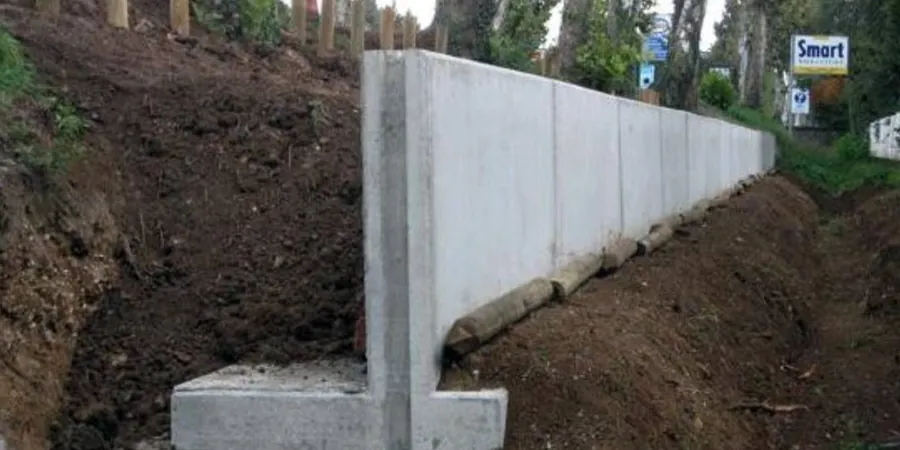
A retaining wall in Irvine's claystone foothills requires different design assumptions than one on river alluvium. One standard does not fit all.
Methodology and scope
Local considerations
Irvine sits in Seismic Zone 4. The 2014 La Habra earthquake (M5.1) triggered minor landslides in nearby canyons. A poorly designed retaining wall can overturn or slide under seismic loads. Water buildup behind the wall is a second major risk — especially after winter storms. Saturated backfill doubles lateral pressure. We always include a drainage blanket and weep holes. Our retaining wall designs factor in both static and pseudo-static conditions per ASCE 7-16. We also check global stability: the wall plus the slope behind it must be stable as a system. Neglecting these risks means costly repairs or structural failure.
Applicable standards
AASHTO LRFD Bridge Design Specifications (9th Ed., 2020), IBC 2021 – Section 1807 (Retaining Walls), ASCE 7-16 – Seismic Loads (Ch. 11 & 12), ASTM D1586-18 (Standard Penetration Test)
Associated technical services
Gravity and Cantilever Wall Design
Analysis of concrete or masonry walls using Rankine and Coulomb earth pressure theories. We size the base for bearing and sliding resistance. Overturning checks include seismic surcharge. Suitable for walls up to 12 ft in height.
Mechanically Stabilized Earth (MSE) Walls
Design of reinforced soil walls with geogrid or steel strips. We calculate pullout resistance and internal stability. MSE walls are cost-effective for highway or large commercial projects in Irvine. We follow FHWA guidelines.
Segmental Retaining Wall (SRW) Systems
Design of modular block walls with geogrid reinforcement. We verify connection strength between blocks and facing. SRWs are common for residential terraces and landscape grading in Irvine. We check for differential settlement at soil transitions.
Typical parameters
Frequently asked questions
How much does retaining wall design cost in Irvine?
The typical cost for engineered retaining wall design in Irvine ranges between US$1,150 and US$4,160. This depends on wall height, soil complexity, and the need for seismic analysis. A simple gravity wall under 4 ft may be at the lower end. A tall MSE wall with surcharge loads can reach the upper range.
Do I need a geotechnical report before designing a retaining wall?
Yes. The Irvine Building Division requires a soils report for any wall over 4 ft in height or supporting a surcharge. The report provides soil strength, groundwater depth, and seismic site class. Without it, the wall design is incomplete and may not pass plan check.
What is the difference between a gravity wall and a cantilever wall?
A gravity wall relies on its own weight to resist overturning. It is typically made of mass concrete or stone. A cantilever wall uses a reinforced concrete stem and base slab. The base extends under the backfill, using the weight of soil on the heel for stability. Cantilever walls are taller and more material-efficient.