Irvine's subtropical climate, with an average annual rainfall of just 13 inches concentrated in winter, creates a unique challenge: the city's deep alluvial soils, deposited by ancient floodplains, remain saturated for weeks after each storm. These soft clays and silts, typical of the Irvine Subbasin, have low permeability and high compressibility, making them prone to long-term settlement under load. Prefabricated vertical drain design in Irvine directly addresses this by providing engineered drainage paths that accelerate consolidation. Without a properly designed PVD system, structures on these deposits can experience differential settlement exceeding allowable limits. The approach here combines site-specific soil characterization with analytical modeling to ensure that the vertical drains match the soil's drainage coefficient and the project's timeline. Before installing PVDs, one must also confirm the soil's strength parameters via a study of bearing capacity and settlement to calibrate the design assumptions.
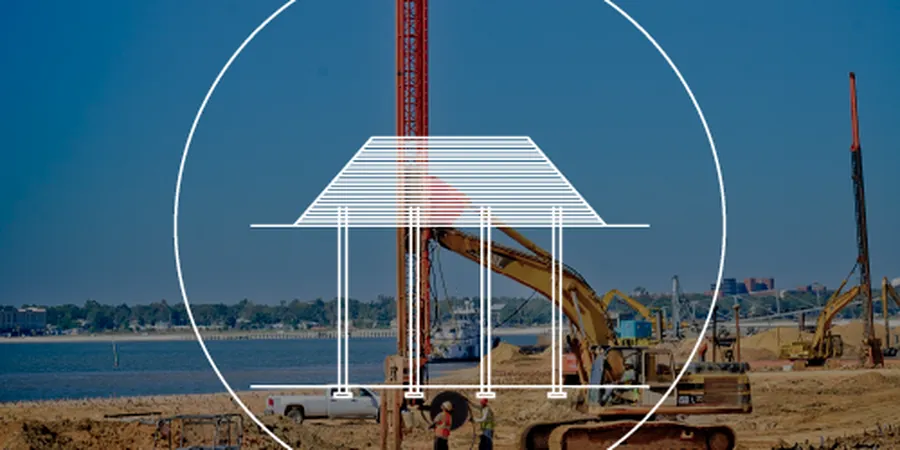
Anisotropic permeability in Irvine clay can delay consolidation by 30% if not accounted for in PVD design.
Methodology and scope
- Boring and sampling to define soil layering and compressibility
- Laboratory consolidation tests (ASTM D2435) to determine Cv and Ch
- Selection of drain spacing and pattern based on Taylor's theory or Carillo's method
- Integration with a surcharge or preloading program to achieve required post-construction settlement
Local considerations
In Irvine, one often sees PVD designs that ignore the smear zone created during installation. The mandrel insertion remolds the adjacent soil, reducing its horizontal permeability by a factor of 2 to 5. If the design neglects this, the actual consolidation time can be double the prediction. Another local risk is the presence of thin sand lenses interbedded with clay; these can act as unintended horizontal drains, altering the flow pattern. A careful PVD design in Irvine must model these heterogeneities to avoid over-optimistic schedules. Using field instrumentation like piezometers and settlement plates during the surcharge period is the only way to verify performance and adjust the program if needed.
Explanatory video
Applicable standards
ASTM D2435 (Consolidation properties), ASTM D1586 (SPT for soil classification), FHWA NHI-05-037 (Ground improvement guidelines)
Associated technical services
Site Investigation & Soil Characterization
Detailed boring, sampling, and laboratory consolidation tests to define soil compressibility, permeability, and anisotropy for accurate PVD design.
Drain Spacing & Pattern Optimization
Analytical and numerical modeling to determine optimal drain spacing, pattern (square or triangular), and installation depth, balancing consolidation time with cost.
Performance Monitoring & Adjustment
Installation of piezometers and settlement plates during surcharge to monitor pore pressure dissipation and adjust the PVD program if actual behavior deviates from predictions.
Typical parameters
Frequently asked questions
How does PVD design differ for Irvine clay compared to other regions?
Irvine's alluvial clays often have anisotropic permeability, with horizontal flow significantly faster than vertical. A standard isotropic design can underestimate consolidation time by 30% or more. Our approach incorporates site-specific Ch/Cv ratios from lab tests to produce a realistic schedule.
What is the typical cost range for a PVD design study in Irvine?
The cost for a PVD design study in Irvine typically ranges from US$830 to US$2,340, depending on the number of borings, laboratory tests required, and the complexity of the numerical modeling. This includes field investigation, lab testing, and a detailed design report.
Can PVDs be combined with other ground improvement methods in Irvine?
Yes, PVDs are often paired with surcharge or preloading to accelerate consolidation. In some projects, they are used alongside deep soil mixing or stone columns for very soft layers. We evaluate each site to recommend the most effective combination.
How long does a PVD design typically take from initial site visit to final report?
A typical PVD design in Irvine takes 4 to 6 weeks. This includes 1-2 weeks for field investigation and sampling, 2-3 weeks for laboratory testing, and 1 week for analysis and report preparation. Urgent projects can be expedited.