The sandy alluvium near John Wayne Airport behaves nothing like the clay-rich soils around the Great Park. That contrast defines geocell design in Irvine. A geocell system must account for these variations — the loose sands in the south require deeper confinement, while the expansive clays near University Town Center demand careful drainage integration. We pair each geocell layout with a prior soil mechanics study to calibrate the cell depth and infill material. Without that baseline, the cells either sink or bulge. Our team runs the numbers for every Irvine project, matching the geocell geometry to the actual ground conditions.
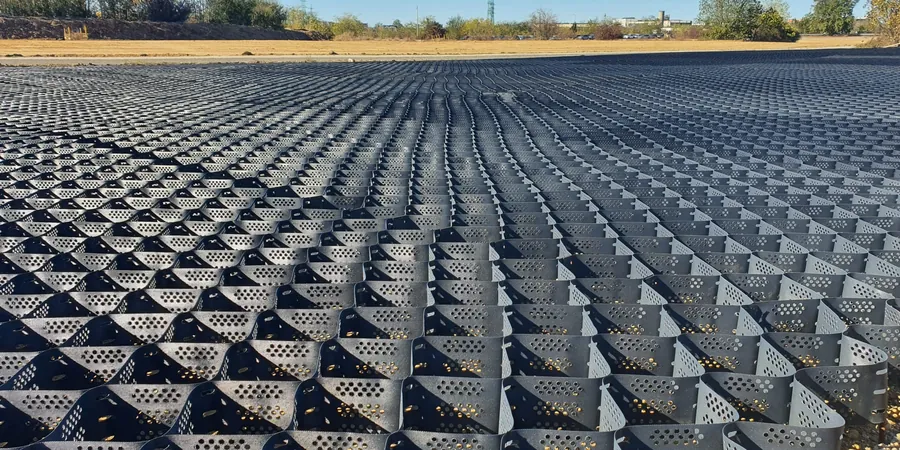
Geocell design in Irvine must account for alluvial sands, expansive clays, and seismic site class D — one geometry does not fit all.
Methodology and scope
- Traffic load class — from pedestrian paths to fire lanes
- Subgrade modulus measured via plate load test
- Drainage layer thickness to avoid hydrostatic uplift
Local considerations
The biggest risk we see in Irvine geocell design is underestimating hydrostatic pressure. After a wet winter, the perched water table rises fast — especially around the San Diego Creek floodplain. If the geocell system lacks a proper drainage blanket or the cells are too shallow, the whole pavement lifts. We use a 300 mm granular subbase with geotextile separation to mitigate that. Another common issue is using a single geocell height across variable subgrades. The loose sands near the Spectrum need deeper cells than the stiff clays near Woodbridge. Ignoring that difference causes differential rutting within two years.
Applicable standards
IBC 2021 (Section 1806 — Bearing Capacity), ASCE 7-22 (Seismic Site Class D/E), ASTM D4884 (Seam Strength for Geocells), AASHTO M288 (Geotextile Specifications)
Associated technical services
Slope Reinforcement with Geocells
Design of geocell systems for slopes up to 1:1 in Irvine's hillside developments. Includes stability analysis per FHWA-NHI-05 and drainage layer specification.
Road Base Stabilization
Geocell design for access roads, fire lanes, and parking lots. We calculate cell height and infill gradation based on subgrade CBR and traffic load class.
Retaining Wall Soil Confinement
Integration of geocells behind MSE walls and abutments to reduce lateral earth pressure. Designed per AASHTO LRFD with local alluvial soil parameters.
Typical parameters
Frequently asked questions
What is the typical cell height used for road base in Irvine?
For most Irvine road applications we specify 100 mm or 150 mm cells. The choice depends on subgrade CBR — weaker soils (CBR < 5) require 150 mm cells with a thicker granular infill.
How do you handle the high water table in Irvine for geocell design?
We include a 300 mm granular drainage layer below the geocell mattress plus a nonwoven geotextile separator. The cells themselves are perforated to allow lateral drainage.
Does geocell design account for seismic loads in Irvine?
Yes. Irvine is in seismic site class D or E per ASCE 7. The geocell system is analyzed for horizontal acceleration and liquefaction-induced settlement. The cell geometry and infill are adjusted accordingly.
How much does a geocell design study cost in Irvine?
A full geocell design with site-specific parameters typically ranges between US$860 and US$2,560. The final cost depends on the area extent and the number of subgrade tests required.
Can geocells be used on Irvine's expansive clay soils?
Yes, but we add a moisture barrier layer beneath the cells and use a non-expansive granular infill. The cell height is increased to 150 mm to distribute the swelling pressure evenly.