Irvine’s planned growth since the 1960s transformed former coastal sage and agricultural land into a master-planned city. The underlying geology, however, hasn’t changed. Much of Irvine sits on Quaternary alluvium and older terrace deposits — loose sands, silts, and occasional clay lenses that can settle unevenly under load. Early developments in the Woodbridge and Turtle Rock areas encountered variable soil stiffness, which led to foundation adjustments. A proper soil mechanics study is the only way to map these variations before design. In Irvine, where seasonal rainfall can raise the groundwater table near the Santa Ana River, combining a soil mechanics study with an infiltration test helps avoid post-construction drainage surprises.
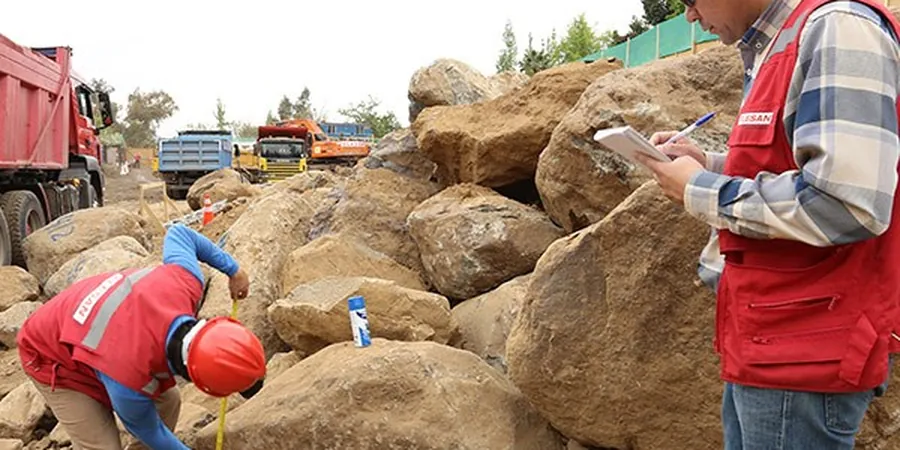
Irvine’s alluvial soils can vary from dense sands to soft silts within 50 m — a soil mechanics study maps that variability before foundation design.
Methodology and scope
- Borehole logging and SPT (ASTM D1586) to measure blow counts layer by layer.
- Atterberg limits and grain-size distribution for shrink-swell potential.
- Groundwater monitoring during wet season (typically Nov–Mar).
Local considerations
Compare the sandy terrace of Quail Hill with the low-lying flats near the Irvine Spectrum. In Quail Hill, older alluvium yields SPT N-values above 30 — competent bearing for shallow foundations. Near the Spectrum, fill soils and recent floodplain deposits show N-values as low as 5, with high fines content that can liquefy under seismic shaking. Without a soil mechanics study, a foundation designed for the terrace would fail in the floodplain. The difference is not academic; it dictates whether a mat foundation or deep piles are needed. Irvine’s seismic zone (ASCE 7 Site Class D or E) amplifies the risk of differential movement, especially where fill depth varies.
Explanatory video
Applicable standards
ASTM D1586-18 (Standard Test Method for SPT), ASTM D2487-17 (Standard Practice for Classification of Soils for Engineering Purposes), ASCE 7-22 (Minimum Design Loads and Associated Criteria for Buildings and Other Structures), IBC 2021 (International Building Code, Chapter 18 – Soils and Foundations)
Associated technical services
Subsurface Exploration & Sampling
Boreholes to 12 m depth with SPT and undisturbed tube sampling. Logging by a certified engineering geologist. Groundwater monitoring wells installed when needed.
Laboratory Classification & Strength Testing
Grain-size analysis, Atterberg limits, moisture-density relationships, and direct shear or triaxial compression. Results reported with ASTM standard references.
Foundation Recommendations & Seismic Site Class
Bearing capacity, settlement estimates, and liquefaction assessment per NCEER guidelines. Final report includes allowable bearing values and recommended foundation type.
Typical parameters
Frequently asked questions
What does a soil mechanics study include for a typical Irvine residential lot?
It includes two to three borings to 8–10 m depth, SPT blow counts every 1.5 m, soil classification (USCS), groundwater observation, and a summary of allowable bearing capacity and settlement. For a single-family home, the report also provides a seismic site class per ASCE 7.
How long does the study take and when should I order it?
Fieldwork takes 1–2 days; lab testing and reporting add 5–7 business days. Order the study during schematic design — before structural drawings — so foundation recommendations can be incorporated without redesign delays.
Do Irvine’s expansive soils affect the study results?
Yes. Clay lenses in the alluvium can have moderate expansion potential (PI > 25). The study identifies these layers and recommends either removal, moisture conditioning, or a stiffened slab to mitigate heave. We always test at least one sample for swell-consolidation when clays are present.
How much does a soil mechanics study cost in Irvine?
The typical range is between US$3,310 and US$5,400 for a standard residential or small commercial project. The final cost depends on boring depth, number of borings, and the extent of laboratory testing required. We provide a detailed scope-based quote before fieldwork starts.