The alluvial soils of Irvine, deposited by ancient wash channels draining the Santa Ana Mountains, create a complex subsurface profile. Silt and clay layers alternate with loose sands, making undrained shear strength a critical parameter. A triaxial test provides the cohesion and friction angle values needed for bearing capacity and slope stability calculations. Before any deep foundation design in Irvine, engineers typically request a consolidated-undrained triaxial test with pore pressure measurement. This data directly supports the IBC and ASCE 7 load combinations used in Orange County.
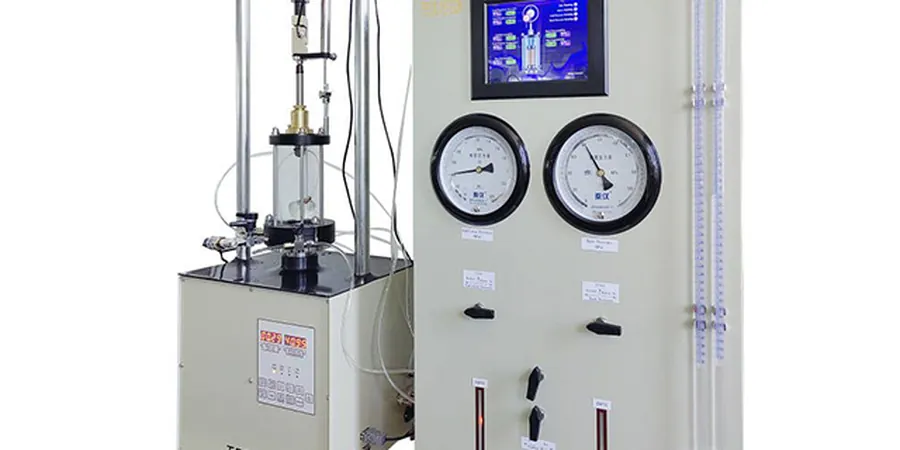
A single triaxial test on a poorly-graded sand from Irvine can show the difference between liquefiable and non-liquefiable behavior under cyclic loading.
Methodology and scope
Local considerations
Irvine has a 2024 population exceeding 300,000 and lies within Seismic Zone 4 per the IBC. The 2014 La Habra earthquake (M5.1) caused localized liquefaction and lateral spreading in nearby alluvial basins. Without triaxial test data, design teams underestimate pore pressure buildup in silty sands during strong shaking. A CU test with pore pressure monitoring directly quantifies the effective stress loss that triggers liquefaction. This is not a theoretical exercise: the California Geological Survey maps several liquefaction hazard zones within Irvine city limits.
Applicable standards
ASTM D2850-15 (UU Triaxial), ASTM D4767-11 (CU Triaxial with Pore Pressure), ASTM D7181-11 (CD Triaxial), IBC 2021 Section 1806 (Bearing Capacity), ASCE 7-22 Chapter 11 (Seismic Site Class)
Associated technical services
UU Triaxial (Unconsolidated-Undrained)
Rapid test on undisturbed samples for immediate bearing capacity estimates. Ideal for shallow foundations and temporary excavations in Irvine's silty clays.
CU Triaxial with Pore Pressure
Consolidated-undrained test measuring effective stress parameters. Required for seismic slope stability and liquefaction assessment in Irvine's alluvial sands.
CD Triaxial (Consolidated-Drained)
Slow drained test for long-term strength. Used for earth dam design, embankment stability, and permanent retaining walls in Orange County.
Typical parameters
Frequently asked questions
What is the difference between UU, CU, and CD triaxial tests?
UU tests do not allow drainage during consolidation or shearing; they provide total stress parameters (Su). CU tests allow consolidation under confining pressure before undrained shearing with pore pressure measurement, yielding effective stress parameters (c', phi'). CD tests allow full drainage throughout, giving drained strength for long-term loading. Each type corresponds to a different field condition.
How much does a triaxial test cost in Irvine?
The typical cost for a CU triaxial test with three confining pressures ranges from US$2,000 to US$2,420, depending on sample preparation and reporting requirements. UU tests are usually less expensive. Volume discounts apply for multi-specimen projects.
Can a triaxial test detect liquefaction potential in Irvine soils?
Yes. A CU test with pore pressure measurement shows how quickly excess pore pressure builds during undrained shearing. When the pore pressure ratio (Ru) approaches 1.0, the soil loses effective stress. This behavior correlates well with cyclic liquefaction resistance for silty sands found in Irvine's alluvial deposits.
What sample quality is required for a triaxial test?
We need undisturbed thin-walled tube samples (typically 3-inch or 5-inch diameter) extruded and trimmed in the lab. Samples must be minimally disturbed during transport. For cohesionless sands, we can reconstitute specimens at target density if undisturbed sampling is not possible.