We recently worked on a four-story commercial building near the Irvine Spectrum. The project called for a cut slope along the property line, and the geotechnical report needed a reliable factor of safety calculation before the city would approve the shoring permit. In our experience, Irvine's alluvial deposits — sands, silts, and gravels with varying densities — require careful consideration of both static and seismic loading. We start by collecting undisturbed samples and running direct shear tests to get peak and residual strength parameters. Then we model the most critical failure surface using limit equilibrium software. For that job, the target FS was 1.5 under static conditions, but we also had to check against the 1.1 minimum for pseudo-static seismic loads per IBC requirements. The factor of safety calculation isn't just a number; it's the basis for safe excavation and foundation design. Before we finalize any analysis, we often cross-check with a losa de cimentacion study when the bearing stratum is shallow, or with a ensayo triaxial if the soil is cohesive and the loading is rapid.
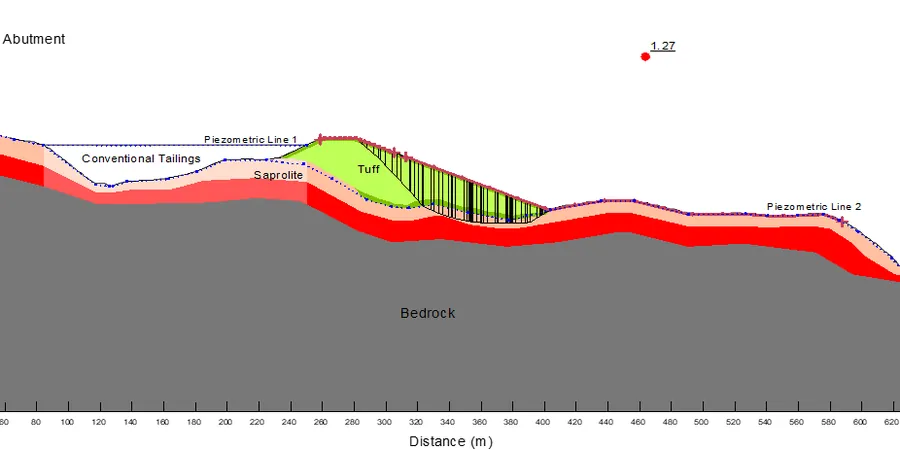
A factor of safety calculation without site-specific strength parameters is just a guess. In Irvine's alluvial soils, that guess can cost you.
Methodology and scope
Key parameters we include in every factor of safety calculation:
- Effective cohesion (c') and friction angle (φ') from direct shear or triaxial tests
- Total unit weight of soil (γ) from undisturbed samples
- Pore pressure ratio (ru) based on phreatic surface observations
- Seismic coefficient (kh) per ASCE 7 site class — Irvine is mostly Site Class D
Local considerations
The most common risk we see in Irvine is underestimating the effect of perched water. A shallow water table can develop after heavy rain, saturating the colluvium over bedrock. If the factor of safety calculation assumes dry conditions, the FS can drop below 1.0 during a storm. That's how retaining walls fail. We always install vibrating-wire piezometers to monitor pore pressure in real time. Also, looser sand layers can liquefy during a seismic event. We run liquefaction triggering analysis using the NCEER method and adjust the factor of safety calculation accordingly. If the FS comes out below 1.0, we recommend ground improvement.
Applicable standards
ASCE 7-16 (Minimum Design Loads and Associated Criteria for Buildings and Other Structures), IBC 2021 (International Building Code, Chapter 18 – Soils and Foundations), ASTM D3080-18 (Direct Shear Test of Soils Under Consolidated Drained Conditions), ASTM D4767-11 (Consolidated Undrained Triaxial Compression Test on Cohesive Soils)
Associated technical services
Slope Stability Analysis
We model circular and non-circular failure surfaces using limit equilibrium methods (Bishop, Spencer, Morgenstern-Price). All analyses include seismic loading and groundwater effects specific to Irvine's alluvial soils.
Foundation Bearing Capacity Check
Using the same shear strength parameters from the factor of safety calculation, we compute allowable bearing pressure for shallow foundations per IBC. We also check for bearing failure under eccentric or inclined loads.
Retaining Wall Design Review
Our team verifies the factor of safety for sliding, overturning, and bearing pressure on retaining walls. We account for active and passive earth pressures plus any surcharge from adjacent structures or traffic.
Liquefaction Hazard Assessment
For Irvine sites near the San Joaquin Hills or in areas with loose sands, we evaluate liquefaction triggering using SPT-based methods (Youd-Idriss 2001). If the factor of safety calculation indicates high risk, we recommend mitigation measures.
Typical parameters
Frequently asked questions
What is the typical factor of safety required for a slope in Irvine?
For permanent slopes under static conditions, IBC requires a minimum FS of 1.5. For temporary excavations that will be open less than 6 months, we often use 1.3. Under seismic loading, the pseudo-static analysis typically targets an FS of 1.1 per ASCE 7. These values assume that the soil strength parameters are determined from site-specific tests.
How much does a factor of safety calculation cost in Irvine?
The cost for a complete factor of safety calculation — including sampling, laboratory testing, and analysis — generally falls between US$610 and US$1,480. The final price depends on the number of failure surfaces analyzed, the complexity of the soil profile, and whether seismic loading is required. Contact us for a precise quote based on your project scope.
What soil parameters are most critical for the factor of safety calculation?
The two most important parameters are the effective cohesion (c') and the effective friction angle (φ'). These come from direct shear or triaxial tests on undisturbed samples. Also critical are the total unit weight of the soil and the location of the groundwater table. In Irvine, the water table can vary significantly between the coastal plain and the foothills, so we always measure it during the site investigation.
Can you perform the factor of safety calculation for an existing retaining wall in Irvine?
Yes, we routinely evaluate existing retaining walls. We take soil samples from behind the wall, measure the groundwater level, and run the factor of safety calculation for sliding, overturning, and bearing capacity. If the existing FS is below 1.5, we can recommend remedial measures such as tieback anchors or soil nailing.