The setup is straightforward but precise. A steel plate, typically 300 mm to 600 mm in diameter, sits on a leveled surface at the test depth. A hydraulic jack bears against a reaction beam anchored by kentledge or screw piles. Dial gauges measure settlement. For Irvine projects, we often use a 457 mm plate because the soil profile here—silty sands over older alluvium—requires enough bearing area to engage a representative volume. Before each plate load test, we verify the reaction system can resist at least 1.5 times the expected load. This avoids unsafe tilting. We also check that the bearing plate is machined flat to within 0.25 mm. Small details matter when the data will size a footing in Irvine.
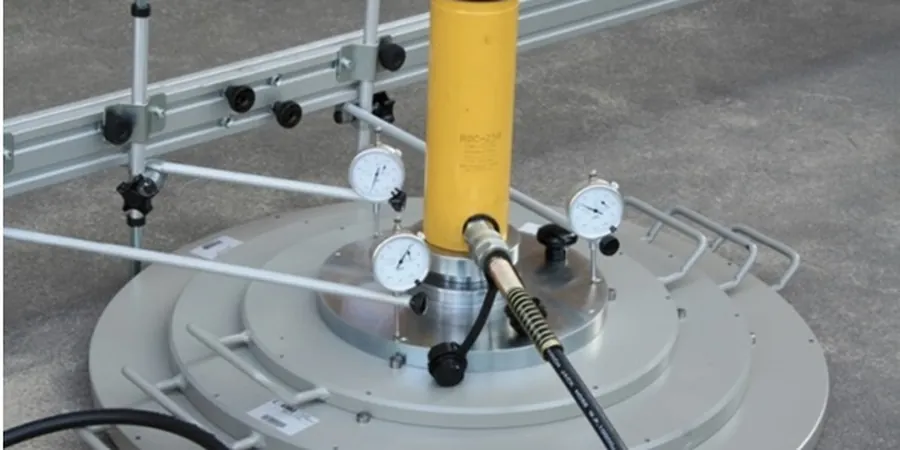
A 457 mm plate at working load gives a settlement modulus that can halve the required footing width in Irvine’s alluvium.
Methodology and scope
Local considerations
IBC 2021 Section 1806 requires a plate load test when presumptive bearing capacities are used and the building official demands site-specific data. In Irvine, the main risk is underestimating settlement on older alluvial fans. These soils appear stiff from a pocket penetrometer but can exhibit creep under sustained loads. A single plate load test at one depth may miss a weak layer just below. We always require a test pit or borehole log to confirm the soil profile before interpreting PLT results. Without that context, the test can overestimate the real bearing capacity by 30% or more.
Applicable standards
ASTM D1196/D1196M-12 (Standard Test Method for Nonrepetitive Static Plate Load Tests), ASTM D1195/D1195M-09 (Repetitive Static Plate Load Tests for subgrade modulus), IBC 2021 Chapter 18 (Soils and Foundations) – Section 1806.2, FHWA NHI-05-037 (Soils and Foundations Reference Manual, Chapter 8)
Associated technical services
Static Plate Load Test (ASTM D1196)
Single-cycle loading to determine the ultimate bearing capacity and modulus of subgrade reaction. Ideal for footing design in Irvine’s alluvial sands and silts. We provide load-settlement curves and k-value calculations.
Repetitive Plate Load Test (ASTM D1195)
Multiple loading cycles to simulate traffic or crane pad conditions. Used for pavement design on Irvine’s arterial roads and large commercial slabs. The test reveals resilient modulus and plastic deformation.
In-Place Bearing Capacity for Shallow Foundations
Direct bearing capacity test at foundation depth using a 457 mm or 610 mm plate. We correlate results with soil classification and water table depth. Recommended for residential and low-rise commercial projects in Irvine.
Typical parameters
Frequently asked questions
What is the difference between a plate load test and a CBR test?
A plate load test measures soil bearing capacity and modulus of subgrade reaction under a static load applied at field moisture and density. A CBR test is a laboratory penetration test used for pavement design. The plate load test gives more realistic values for foundation design because it tests the soil in situ at the actual depth.
How deep should the plate load test be performed in Irvine?
The test should be performed at the proposed foundation bearing depth, typically 1 to 3 feet below grade for shallow footings. For Irvine’s alluvial soils, we recommend testing at least two depths if the soil profile changes within the first 5 feet. This avoids missing a loose layer that could cause differential settlement.
What size plate is used for the test?
The plate diameter is usually 300 mm, 457 mm, or 610 mm. For fine-grained or layered soils like those in Irvine, a 457 mm plate is common because it engages a soil volume about 2 to 3 times the plate diameter in depth. Larger plates are used for gravelly sands to reduce scale effects.
How much does a plate load test cost in Irvine?
The typical cost for a plate load test in Irvine ranges between US$740 and US$1,440 per test point. This includes mobilization, setup, loading to failure or design load, and a report with load-settlement curves. Additional charges apply for deep excavations or multiple test locations.