Many construction firms in Irvine assume that once a slope is cut, it stays stable. That assumption has led to costly delays and emergency shoring on several projects near the Santa Ana mountain foothills. Monthly geotechnical slope monitoring catches early creep, pore pressure changes, and surface cracking before they become failures. Without it, a dry-season inspection can miss the slow movement triggered by winter rains. The team integrates inclinometer readings with automated dataloggers and periodic survey targets to build a movement history. For deeper understanding of subsurface conditions, they pair the monitoring with [MASW profiles](/masw-vs30/) to map velocity contrasts across the slope. That combined data set allows engineers to calibrate models and set action thresholds specific to Irvine's layered alluvium and weathered bedrock.
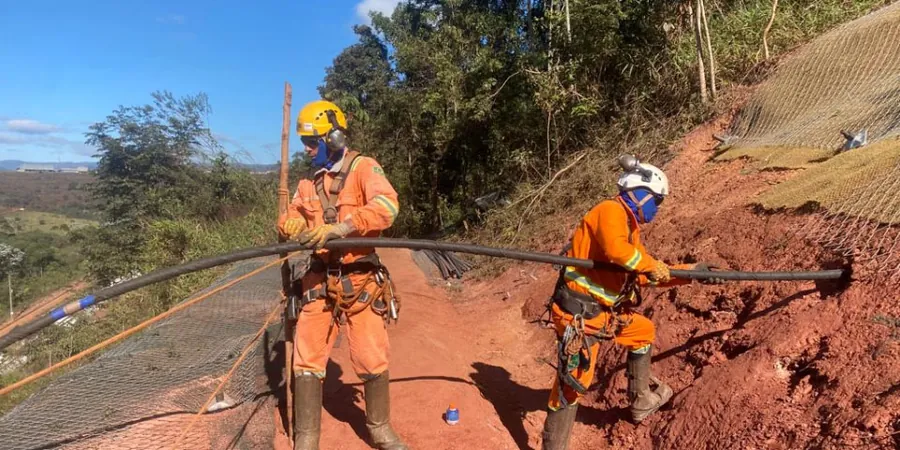
Alert levels set at 0.25 inches cumulative movement — anything faster demands immediate remedial action under ASCE 7 guidelines.
Methodology and scope
Local considerations
A 40-foot cut slope on a mixed-use development near the Irvine Spectrum began showing hairline cracks after a heavy El Niño winter. The contractor had no monitoring in place. By spring the crack width exceeded 0.5 inches, and the retaining wall design had to be redesigned from a tieback anchor system to a soldier pile wall with deep drainage. That change added four months and over $200,000 in unplanned costs. A monthly geotechnical slope monitoring program would have detected the accelerating creep by the second rain event, allowing time for a drainage blanket installation before movement progressed. In Irvine's variable geology, waiting until visual signs appear is already too late.
Applicable standards
ASCE 7-22 Minimum Design Loads (Chapter 15 – Slope Stability), ASTM D6230-18 Standard Test Method for Inclinometer Monitoring, ASTM D4750-15 Standard Test Method for Piezometer Installation
Associated technical services
Inclinometer installation and survey
Permanent casing grouted into boreholes to depths of 60 feet. Monthly manual surveys with 0.01-inch resolution. Data plotted as cumulative displacement versus depth.
Piezometer network and data logging
Vibrating-wire piezometers installed in nested boreholes to measure perched and deep groundwater. Automated loggers record hourly readings, with monthly download and trend analysis.
Surface crack mapping and survey
Fixed survey targets on crack flanks and slope benches. Monthly total station surveys detect opening or offset. Combined with inclinometer data to correlate surface and subsurface movement.
Typical parameters
Frequently asked questions
How is monthly geotechnical slope monitoring different from a one-time inspection?
A one-time inspection gives a snapshot. Monthly monitoring builds a time series. You see whether movement is accelerating, decelerating, or stable. That trend is what triggers action. In Irvine, where winter rainfall can change pore pressures quickly, the monthly interval catches seasonal effects that a single visit misses.
What instruments are typically used for this service?
The standard set includes inclinometer casings to measure horizontal displacement, vibrating-wire piezometers for pore pressure, and surface survey targets. Depending on site complexity, we also add tiltmeters or crack gauges. All instruments are selected based on the expected movement magnitude and soil type.
How much does monthly geotechnical slope monitoring cost in Irvine?
For a typical slope with three inclinometers and two piezometers, the monthly survey and reporting cost ranges between US$440 and US$1,220. That includes field data collection, reduction, and a written report with vector plots. Installation of the casings and piezometers is a separate upfront cost.
What triggers an alert during the monitoring period?
Alerts are based on cumulative displacement exceeding 0.25 inches or sustained acceleration above 0.1 inches per month. If pore pressure rises more than 5 feet above the seasonal baseline, that also triggers a review. The engineer defines these thresholds during the program setup based on the slope geometry and soil parameters.