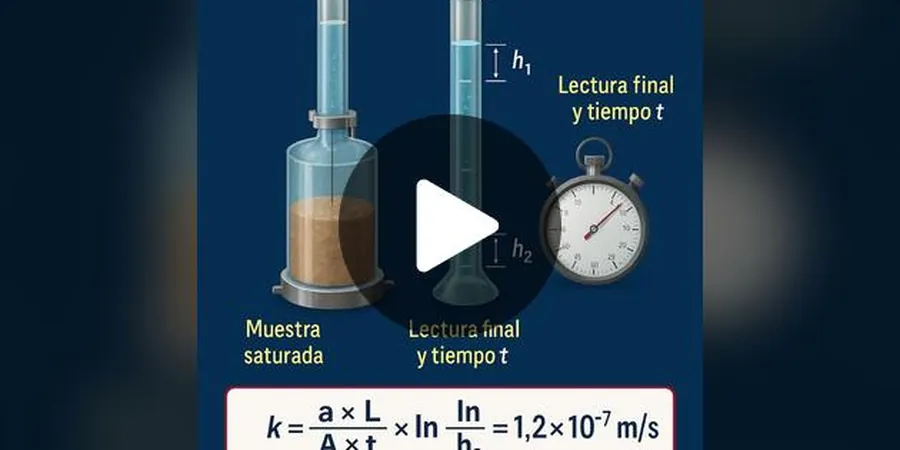
The permeameter setup in our Irvine laboratory accommodates both falling-head and constant-head configurations, using rigid-wall cells for granular soils and flexible-wall triaxial permeameters for cohesive or compacted specimens. Water flows through a saturated sample under a controlled gradient, and the coefficient of permeability (k) is calculated from measured discharge and time. For low-permeability clays we apply a falling-head procedure with narrow standpipes to detect small flow volumes. Before the test we classify the soil per the Unified Soil Classification System and compact it to a target density matching field conditions. This data is essential for sizing drainage layers, designing retaining walls, and evaluating seepage around underground structures. We also cross-reference results with in-situ permeability tests when heterogeneous strata are present.
A single constant-head test on a 10-cm sample may not capture the variability of Irvine's layered alluvial profile. Multi-density testing is essential.
Methodology and scope
Local considerations
A mixed-use development in the Irvine Business Complex recently encountered settlement of a slab‑on‑grade after two rainy seasons. The geotechnical report had estimated the subgrade permeability from a single constant‑head test on a clean sand sample, but the actual site contained discontinuous silt lenses that reduced vertical drainage. Water accumulated beneath the slab, causing heave and cracking. Our laboratory avoids this error by testing each soil stratum separately, including the fines‑rich interbeds. We also run a falling‑head test on the compacted clay liner samples to confirm low permeability before the liner is placed. Ignoring the vertical anisotropy of Irvine's alluvial fan deposits leads to under‑designed drainage systems and long‑term moisture damage.
Applicable standards
ASTM D2434 (Constant Head Permeability of Granular Soils), ASTM D5856 (Measurement of Hydraulic Conductivity of Porous Material Using a Rigid-Wall, Compaction-Mold Permeameter), ASTM D5084 (Measurement of Hydraulic Conductivity of Saturated Porous Materials Using a Flexible Wall Permeameter), ASTM D854 (Specific Gravity of Soil Solids by Water Pycnometer)
Associated technical services
Constant Head Permeability (Granular Soils)
Performed on clean sands and gravels using a rigid-wall permeameter with a constant hydraulic gradient. Suitable for drainage layer design and filter evaluation.
Falling Head Permeability (Fine-Grained Soils)
Applied to silts and clays where flow rates are low. Uses a standpipe and falling water column; results are corrected for temperature and void ratio changes.
Flexible Wall Triaxial Permeability
Measures k under confining pressure using back-pressure saturation. Best for undisturbed or compacted samples where stress state affects hydraulic conductivity.
Unsaturated Hydraulic Conductivity
Determines k as a function of matric suction using a Tempe cell or pressure plate extractor. Needed for modeling infiltration and slope stability in partially saturated fills.
Typical parameters
Frequently asked questions
What is the difference between falling-head and constant-head permeability tests?
Constant-head is used for coarse-grained soils (sands, gravels) where flow is fast enough to maintain a steady water level. Falling-head is preferred for fine-grained soils (silts, clays) because it can measure very low flow rates using a narrow standpipe and a falling water column.
Which ASTM standards govern laboratory permeability testing in Irvine?
The primary standards are ASTM D2434 for constant-head tests on granular soils, ASTM D5856 for rigid-wall falling-head tests, and ASTM D5084 for flexible-wall triaxial permeability. All tests are temperature-corrected and reported at 20°C.
How much does a laboratory permeability test cost in Irvine?
The typical cost ranges between US$420 and US$600 per test, depending on sample size, method (constant vs. falling head), and whether compaction is required. Volume discounts apply for projects with multiple strata.
How does soil layering in Irvine affect permeability results?
Irvine's alluvial fan deposits contain interbedded sands, silts, and clays. A single test on one layer may not represent the overall drainage behavior. We recommend testing each stratum separately and using the harmonic mean for vertical flow calculations in layered profiles.