Stone column design in Irvine demands a solid grasp of the local alluvial geology and the governing codes. We work under ASCE 7-22 and IBC 2021, referencing ASTM D1586 for SPT correlations and ASTM D2487 for soil classification. Irvine's subsurface profile often presents loose sands and silty clays down to 15 meters, conditions where stone columns can deliver a 30% to 50% increase in bearing capacity. Before we finalize any layout, we run a detailed ensayo SPT campaign to map the weak layers and check for liquefaction susceptibility. The goal is to design a stone column grid that densifies the soil matrix and reduces total and differential settlements under working loads.
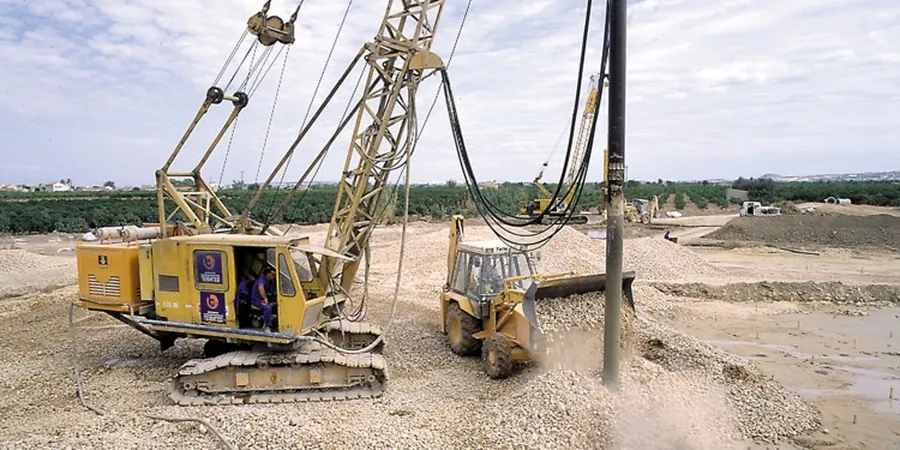
Stone columns can deliver a 30% to 50% increase in bearing capacity in Irvine's loose alluvial soils when designed with proper spacing and stone gradation.
Methodology and scope
Local considerations
A 10-story condominium project near the San Diego Creek in Irvine hit a snag when the original foundation design assumed a uniform bearing layer at 8 meters. After we ran a seismic site response analysis, we found a discontinuous clay seam at 6 meters that could cause differential settlement under the tower core. We redesigned the ground improvement using stone columns to bridge that seam and transfer loads to the denser sands below. Without that intervention, the structure would have experienced settlements exceeding 50 mm between adjacent columns. The lesson is clear: in Irvine's variable alluvium, a single boring per building corner isn't enough. You need a phased investigation that feeds into the stone column design as you go.
Applicable standards
ASCE 7-22 (Seismic Loads & Site Classification), IBC 2021 (Chapter 18 – Soils & Foundations), ASTM D1586-18 (Standard Test for SPT), ASTM D2487-17 (Classification of Soils for Engineering Purposes), FHWA NHI-05-037 (Design & Construction of Stone Columns)
Associated technical services
Feasibility & Design Study
We review existing geotechnical reports, run additional borings if needed, and produce a stone column layout with spacing, diameter, and depth tailored to the project loads and soil profile.
Construction QA/QC
Our team monitors stone column installation in real time, verifying stone gradation, column diameter, and verticality. We perform plate load tests and CPT checks to confirm the design improvement factors are met.
Seismic & Liquefaction Mitigation
For sites in seismic zones, we design stone columns to densify the soil and relieve excess pore pressure. This reduces liquefaction risk and improves the site class per ASCE 7 without resorting to deep foundations.
Typical parameters
Frequently asked questions
What is the typical cost range for stone column design in Irvine?
For a standard commercial or residential project in Irvine, the design and testing phase typically ranges between US$1.330 and US$5.750. This covers the initial site investigation, numerical modeling, and a detailed installation plan. Large or complex sites with deep soft layers may fall at the higher end of that range.
How do stone columns improve soil bearing capacity?
Stone columns act as vertical drains and reinforcement. They densify the surrounding soil during installation through vibration or displacement, increase the composite shear strength, and reduce the void ratio. In Irvine's alluvium, we typically see a 30% to 50% gain in allowable bearing pressure. The improvement is verified with post-treatment plate load tests.
Are stone columns suitable for liquefaction mitigation?
Yes. Stone columns densify loose granular soils and provide a drainage path for excess pore pressure generated during an earthquake. In Irvine, where the water table is shallow in many areas, this can reduce liquefaction risk significantly. We design the column spacing and diameter based on the SPT N-values and the seismic demand per ASCE 7.
How deep can stone columns be installed in Irvine?
We have installed stone columns up to 18 meters deep in Irvine using bottom-feed vibratory methods. The practical limit depends on the soil profile and equipment. For very deep soft deposits, we sometimes combine stone columns with prefabricated vertical drains to accelerate consolidation before the columns are installed.