In Irvine, the alluvial and terrace deposits that underlie much of the city can vary dramatically within a single block, and we often see projects where assumptions about bearing capacity turn out to be optimistic. Running a Standard Penetration Test at strategic borehole locations gives you measured N-values that directly feed into foundation design for IBC-compliant buildings. The procedure follows ASTM D1586-18 precisely: a 63.5 kg hammer drops 760 mm, the sampler is driven 450 mm, and blow counts are recorded over the final 300 mm. When the soils include older Pleistocene gravels near the Tustin foothills, the test may also be paired with MASW-VS30 to cross-check shear-wave velocity profiles for site class determination under ASCE 7.
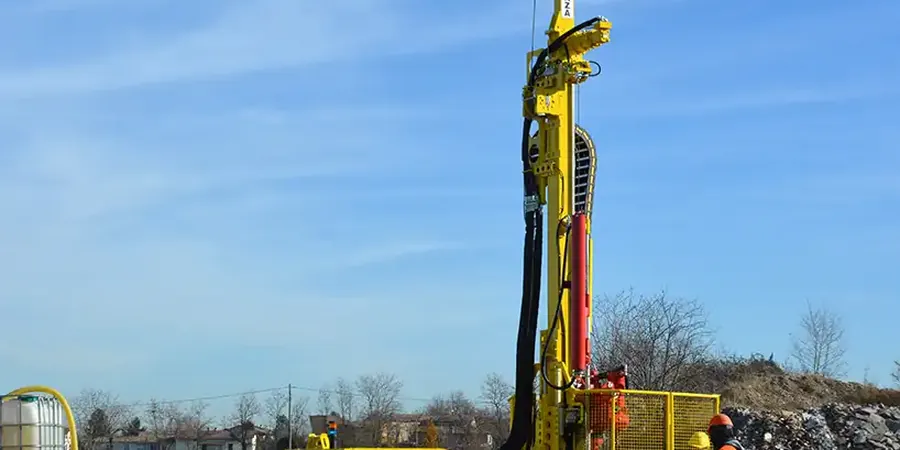
Measured N-values in Irvine vary from 12 in young alluvium near wetlands to over 50 in the older terrace deposits east of the 405.
Methodology and scope
Local considerations
A recurring mistake we see with spec homes and mixed-use projects in Irvine is relying on published geologic maps alone for foundation design. The older Quaternary terraces mapped across the city contain discontinuous clay layers and cemented lenses that can spike N-values in one borehole and drop them 10 meters away. Without a properly spaced SPT program — typically one test per 300 m² of building footprint per IBC Table 1804.1 — the engineer may overestimate bearing capacity and underestimate settlement. The consequence is differential movement under service loads, especially in structures with shallow footings on the variable alluvium near the San Diego Creek corridor.
Applicable standards
ASTM D1586-18 (Standard Test Method for SPT), ASTM D2487-17 (Classification of Soils for Engineering Purposes – USCS), IBC 2021 Chapter 18 (Soils and Foundations), ASCE 7-22 Section 11.4 (Site Class and Seismic Design Parameters)
Associated technical services
SPT Drilling & Field Logging
On-site execution using CME 55 or Diedrich D-50 rigs with automatic hammer. Field logs include blow counts every 150 mm, soil color, moisture, and consistency. Data is transmitted daily to the project geotechnical engineer.
SPT Data Interpretation & Report
Post-field analysis delivering corrected N₁₆₀ values, fines-content adjustment per Seed & Idriss, and site-class assignment per ASCE 7. The report includes borehole logs, grain-size curves, and liquefaction triggering charts (M=7.5, PGA=0.40g for Irvine).
Typical parameters
Frequently asked questions
How many SPT boreholes are required for a typical 10,000 ft² commercial building in Irvine?
IBC Table 1804.1 recommends at least one boring per 3,000 ft² of building footprint. For a 10,000 ft² project, we typically drill 4 to 5 borings with SPT at 5-ft intervals. The Irvine Building Department may request additional borings near the San Diego Creek floodplain or on undocumented fill.
What is the difference between raw N-value and corrected N₁₆₀ in SPT results?
Raw N is the blow count measured in the field. Corrected N₁₆₀ adjusts for hammer efficiency (usually 60% for automatic hammers), borehole diameter, rod length, and overburden pressure. For liquefaction screening in Irvine, we use N₁₆₀ with the NCEER (Youd & Idriss 2001) method. The correction can reduce raw N by 20–40% in the top 30 ft of alluvium.
Does SPT work in the hard Pleistocene gravels found east of the 405 freeway?
Yes, but the split-spoon sampler may encounter refusal (50 blows over 6 inches or less) in these dense layers. When that happens, we switch to a cone penetrometer test (CPT) or large-diamond coring to penetrate the gravel. The hard layers actually indicate high bearing capacity, but you still need N-values to confirm that the underlying stratum is thick enough to support spread footings.
What is the typical cost range for an SPT program on a small residential lot in Irvine?
For a single-family lot requiring 2 to 3 borings with SPT at 5-ft intervals, the cost typically falls between US$540 and US$800 per boring, including field logging, lab classification, and a summary report. Mobilization from our Orange County base adds a flat fee of US$150 to US$250 depending on distance to the site.