A common oversight among construction teams in Orange County is assuming that the soil beneath Irvine’s master-planned communities behaves uniformly across the city. That assumption often leads to premature cracking or pumping in concrete pavements. In our experience, the alluvial fan deposits and old river terraces that underlie much of Irvine create significant variability in subgrade support. A proper rigid pavement design must account for these local soil variations to avoid costly failures. Complementing the pavement analysis with a subgrade evaluation via CBR helps quantify bearing capacity across different zones, while a resistivity survey can identify corrosive soil layers that threaten dowel bars and reinforcement.
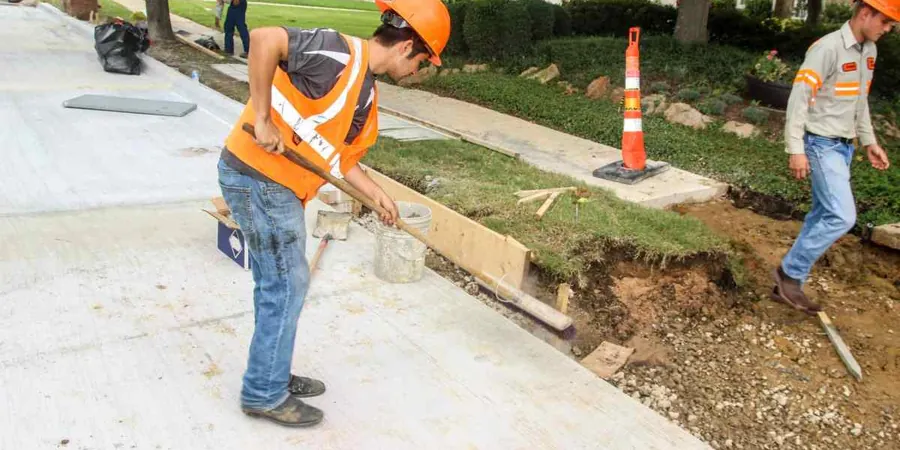
Alluvial fan deposits and old river terraces create significant subgrade variability. A rigid pavement design must account for these local soil variations.
Methodology and scope
Local considerations
Irvine’s population surpassed 310,000 in 2024, and its road network carries increasing truck traffic from distribution centers along the I-5 and I-405 corridors. The last significant seismic event affecting the area was the 2014 La Habra earthquake (M5.1), which caused settlement cracks in several older concrete pavements. Without a proper rigid pavement design that incorporates seismic joint detailing and adequate subgrade drainage, new pavements risk faulting and corner breaks within the first five years. We have seen this repeatedly in Irvine commercial lots where the subgrade was never tested for the expansive clay lenses that are common in the Tustin and Orange Park Acres areas.
Applicable standards
AASHTO LRFD Bridge Design Specifications (8th Edition, 2020), ASTM D1586-18 (Standard Test Method for SPT), ASTM D1883-21 (CBR Test), ACI 325.11R (Design of Concrete Pavements)
Associated technical services
Subgrade Investigation & CBR Testing
Field and laboratory tests to determine the California Bearing Ratio (CBR) and modulus of subgrade reaction (k-value) at proposed pavement depths, using ASTM D1883 protocols.
Structural Pavement Design
AASHTO-based thickness design for concrete slabs, including dowel bar sizing, joint spacing, and tie bar layout, optimized for Irvine’s traffic loads and soil conditions.
Seismic Joint & Detailing Review
Evaluation of joint patterns, load transfer devices, and subgrade drainage to minimize earthquake-induced damage, referencing ASCE 7 and local building code requirements.
Typical parameters
Frequently asked questions
How much does rigid pavement design cost in Irvine?
The typical range for a complete rigid pavement design package in Irvine is between US$1.620 and US$7.060, depending on the project size, number of test pits, and laboratory testing required.
What soil conditions in Irvine affect rigid pavement design?
Irvine’s alluvial soils vary from sandy gravels to silty clays. Expansive clay lenses can cause differential heave, while loose sands may require compaction or stabilization before placing concrete. A thorough subgrade investigation is essential.
Do I need seismic joints for concrete pavements in Irvine?
Yes. Irvine lies in a seismically active region near several fault zones. Seismic joints with adequate load transfer devices help prevent faulting and corner breaks during ground motion, as recommended by ACI 325.11R.
How long does a rigid pavement design study take?
A typical study, including field testing, lab work, and report preparation, takes 2 to 4 weeks for most Irvine projects. Larger commercial or industrial sites may require additional time for traffic load analysis.