The unconfined compression test (UCS) is performed on undisturbed cohesive soil samples using a load frame with a calibrated proving ring. In Irvine, where alluvial and marine terrace clays are common at depths of 3 to 8 meters, we extract thin-walled tube samples and trim them to standard 1.4-inch-diameter specimens. The test applies axial load at a constant strain rate of 0.5% to 2% per minute until failure occurs. We record peak stress and classify the failure pattern (brittle, plastic, or bulging). This quick, cost-effective method gives undrained shear strength (Su) for preliminary foundation design and slope stability checks. The entire procedure follows ASTM D2166-16 and is performed in our temperature-controlled lab near the I-5 corridor.
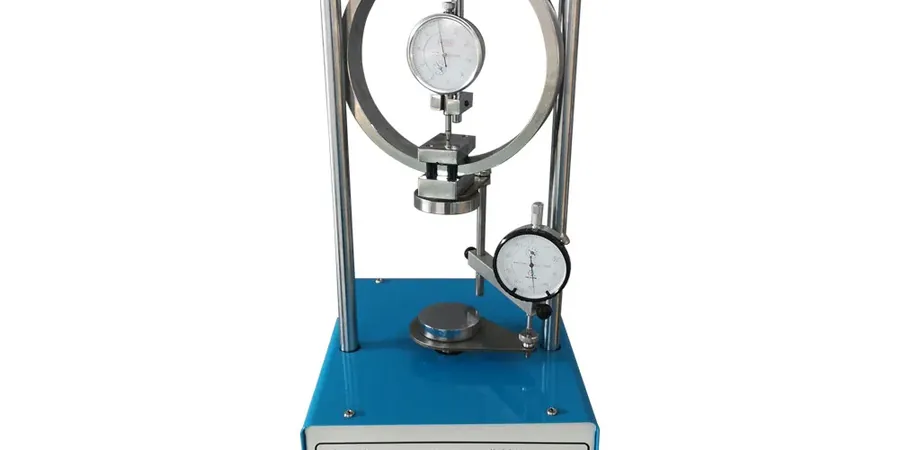
A single UCS test on a 1.4-inch sample can reveal the undrained shear strength of Irvine's alluvial clays in under 15 minutes.
Methodology and scope
- Specimen height-to-diameter ratio of 2.0 to 2.5.
- Strain rate set to produce failure within 10 to 15 minutes.
- Stress-strain curve plotted to determine Su and failure strain.
Local considerations
Soils in the Woodbridge area of Irvine are often soft clay with Su values below 0.5 ksf. In contrast, soils near the Tustin border show stiffer Pleistocene clays exceeding 3 ksf. Relying on a single UCS test without considering this spatial variability can lead to under-designed foundations in one zone and over-designed in another. The risk is real: a 0.2 ksf error in Su for a 3-story building changes the footing width by 15%. In Irvine, we recommend at least one UCS test per soil layer per building footprint, and always pair it with a plate load test for verification when the structure exceeds three stories.
Applicable standards
ASTM D2166-16 (Standard Test Method for Unconfined Compressive Strength of Cohesive Soil), ASTM D1587-15 (Standard Practice for Thin-Walled Tube Sampling), ASTM D2487-17 (Standard Practice for Classification of Soils for Engineering Purposes), IBC 2021 Section 1806 (Presumptive Load-Bearing Values of Soils)
Associated technical services
Standard UCS on Shelby Tube Samples
We receive undisturbed samples in 3-inch-diameter Shelby tubes, trim them to size, and run the UCS test per ASTM D2166. Results include peak Su, failure strain, moisture content, and unit weight. Typical turnaround is 2 business days. Ideal for residential and low-rise commercial foundations in Irvine.
UCS with Stress-Strain Curve Analysis
For projects requiring detailed deformation behavior, we plot the full stress-strain curve and compute the undrained modulus (Eu). This is critical for settlement analysis of mat foundations and for calibrating numerical models. Report includes graphical output and interpretation by a licensed geotechnical engineer.
Typical parameters
Frequently asked questions
What is the difference between UCS and unconsolidated-undrained (UU) triaxial test?
The UCS test applies axial load only, with no confining pressure, so it measures undrained shear strength under zero confinement. The UU triaxial test applies a confining pressure (usually equal to the in-situ overburden) and then shears the sample undrained. UCS gives a lower-bound Su for surface clays; UU gives a more representative value for deeper layers. For Irvine's shallow alluvial clays, UCS is often sufficient for preliminary design.
How many UCS tests are needed for a typical Irvine residential lot?
For a single-family home on a 5,000- to 10,000-square-foot lot, we recommend at least two UCS tests: one from each soil boring at depths of 3 to 6 feet. If the soil profile shows more than one clay layer, add one test per distinct layer. This ensures that the foundation design accounts for variability across the site.
Can UCS be performed on sandy or gravelly soils?
No. The unconfined compression test is only valid for cohesive soils (clays and silts) that can stand unsupported after trimming. Sandy or gravelly soils lack cohesion and will collapse under their own weight. For those soils, we recommend triaxial or direct shear tests. In Irvine, we often encounter sandy layers near the Santa Ana River channel; those require different testing methods.
What is the typical cost range for a UCS test in Irvine?
The cost for a single unconfined compression test in Irvine typically ranges from US$340 to US$490. This includes sample preparation, testing, and a certified report with stress-strain curve. Volume discounts apply for projects requiring five or more tests. Additional charges may apply for expedited turnaround (24-hour service).
How does the UCS test help with foundation design in Irvine's seismic zone?
The UCS test provides undrained shear strength (Su), which is used to calculate bearing capacity and estimate liquefaction-induced settlement in clay layers. For seismic design per ASCE 7, Su is also used in site response analyses and to evaluate cyclic softening potential. In Irvine's Zone 4 seismic region, knowing Su accurately reduces overdesign and ensures the foundation can withstand earthquake loads.