Our rig crew mobilizes a hydraulic drill rig with hollow-stem augers and a calibrated load cell to perform static load tests on pre-driven piles across Irvine's alluvial plains. We instrument each pile with strain gauges at multiple depths to separate skin friction from end bearing during incremental loading cycles. The setup captures load-transfer curves that reveal how the upper 20 to 30 feet of silty sand and clay contribute to shaft resistance versus the denser gravel layers below. Before any test begins, we verify the reaction beam anchorage and confirm the reference beam is isolated from ground vibration, which is critical given Irvine's proximity to active faults like the Elsinore and San Jacinto zones.
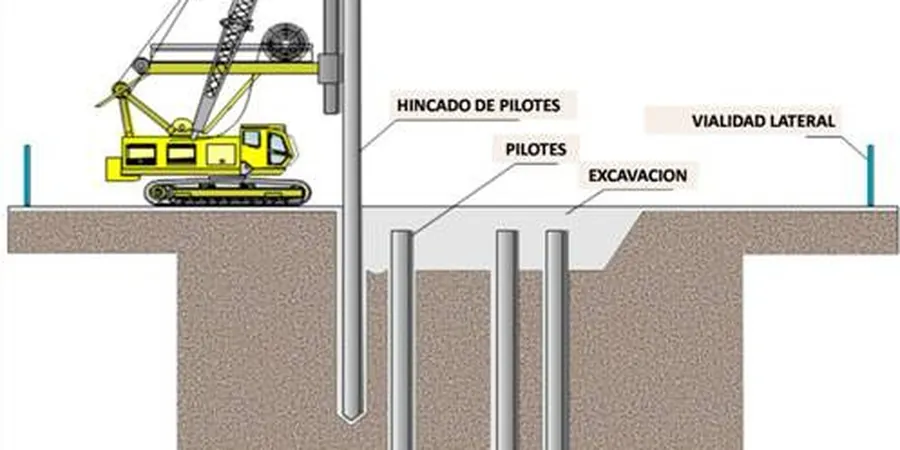
In Irvine's alluvial soils, skin friction often supplies 65-75% of ultimate capacity, making accurate shaft-resistance quantification essential for design economy.
Methodology and scope
Local considerations
IBC 2021 Section 1808.2.2 and ASCE 7-22 require that foundation load tests account for both shaft and tip resistance when the design relies on pile group efficiency. In Irvine, where seismic site class D and E conditions are common, underestimating skin friction degradation due to cyclic loading during an earthquake can lead to excessive settlement. We follow the procedures in ASTM D3966-22 to measure side shear under lateral loads and ASTM D1143-20 to isolate end bearing under axial compression, ensuring compliance with local building department requirements.
Applicable standards
ASTM D1143-20 (Static Axial Compressive Load Test), ASTM D3966-22 (Lateral Load Test), IBC 2021 Chapter 18 (Soils and Foundations), ASCE 7-22 (Minimum Design Loads)
Associated technical services
Instrumented Static Load Test
Full-scale pile load test with embedment strain gauges and telltales. We measure load distribution along the shaft and at the tip, producing t-z and Q-z curves that separate skin friction from end bearing. The report includes Davisson failure criterion interpretation and settlement predictions for working loads.
CAPWAP Analysis on PDA Tests
High-strain dynamic testing with a Pile Driving Analyzer (PDA) followed by Case Pile Wave Analysis Program (CAPWAP) signal matching. This method yields shaft resistance distribution and end bearing values without a static load frame, ideal for production piles where time and access are constrained.
Typical parameters
Frequently asked questions
What is the difference between skin friction and end bearing in pile design?
Skin friction is the shear resistance developed along the pile shaft as it displaces soil during loading, while end bearing is the compressive resistance at the pile tip against the underlying soil or rock stratum. In Irvine, where dense gravel layers exist below 30 feet, end bearing often governs ultimate capacity for piles driven to refusal, whereas skin friction dominates for friction piles in the upper clayey silt.
How much does a pile skin friction vs. end bearing analysis cost in Irvine?
The cost typically ranges between US$1,150 and US$3,620 depending on pile size, test method (static vs. dynamic), number of strain gauge levels, and reporting detail. A single instrumented static load test on a 16-inch pile to 50 feet depth generally falls in the middle of that range. Contact us for a firm quote based on your specific project scope.
When should I choose a static load test over CAPWAP analysis for this study?
Static load tests provide direct measurement of load-settlement behavior and are required by IBC for design loads exceeding 200 tons per pile or for projects in seismic site class E. CAPWAP analysis is faster and cheaper but relies on signal matching assumptions; it works well for production piles in uniform soil conditions. In Irvine's variable alluvial deposits, we recommend static tests for critical structures and CAPWAP for preliminary design or quality control on production piles.